Bathala Curry
Sri Lankan Sweet Potato Curry (Bathala Maluwa)
Also known as Sweet Potato Curry
Here's the thing about Sri Lankan sweet potato curry, bathala curry: it's chunks of sweet potato (bathala) simmered until just tender in a spiced coconut milk gravy. Onion, garlic, green chilli, turmeric, curry leaves, pandan, mustard seed and a little roasted curry powder all go in. The sweet potato's natural sugars push against the salt, chilli and a touch of tang, so you get a curry that's gently sweet but firmly savoury. It's creamy, comforting, naturally vegan and genuinely beginner-friendly. This bathala maluwa is everyday rice-and-curry food, the kind that quietly wins people over.

Soft, creamy sweet potato in a spiced coconut gravy, with the vegetable's own sweetness against salt, chilli and tang. Easy, naturally vegan.
- Total time
- 40 min
- 15 min prep · 25 min cook
- Serves
- 4 people
- Difficulty
- Beginner
- Spice level
- Medium
- Country help
- USA · UK · AU · CA substitutes included
CeylonCooking
ceyloncooking.com/recipes/sweet-potato-curry
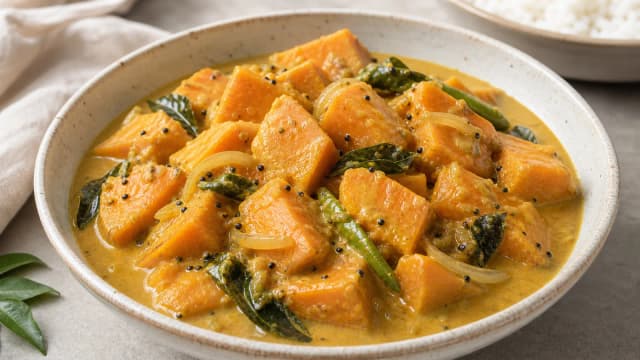
Sri Lankan Sweet Potato Curry (Bathala Curry)
Scan to open on your phone
Nutrition
Estimated values, per serving.
About This Dish
Ask for bathala curry in a Sri Lankan home and you'll get something humble and quietly loved. Bathala means sweet potato, maluwa means curry, so bathala maluwa is exactly what it says: sweet potato curry. Nothing grand. But there's a small trick: the sweet potato goes into a spiced coconut gravy where its sugars have to sit next to salt, chilli and a little sourness, so the dish lands savoury first and sweet second. Done right, it's the kind of curry you go back to without quite knowing why.
This is everyday food, not celebration food. Sweet potato grows easily all over the island, it's cheap and filling, and a wedge of it becomes dinner with little more than an onion, a coconut and a handful of spices. On a rice and curry plate it sits as that soft, rounded note among sharper sambols and fierier curries. It's often one of the first vegetable curries a cook learns because it's so forgiving. Keep it mild for the kids, add more chilli for the adults, and one pot does the whole table.
A good bathala curry is all about the balance between sweet and savoury. The sweet potato's sugar wants to take over, so the cook leans hard the other way: a confident bit of salt, a slit green chilli or two, mustard seeds popped for that nutty pungency, and just enough roasted curry powder to give a toasty, earthy backbone. A squeeze of lime or a little goraka at the end stops it going cloying. The coconut milk brings it together into a creamy gravy that clings to the soft chunks. Mellow, but never flat.
Like most Sri Lankan home cooking, this dish bends to the cook and the day. Some keep it pale and mild, almost a kiri hodi made with sweet potato instead of regular potato, while others go darker with roasted curry powder for extra depth. A pinch of Maldive fish is a common savoury addition, though the base recipe is fully vegan. Make it dry and clinging or loose and gravied, either way a pot of bathala maluwa is the soft, sweet, comforting heart of an otherwise spicy plate.
The Sweet Potato (Bathala), and How It Differs from Regular Potato (Ala)
Bathala is sweet potato, and the variety actually matters here. The common orange-fleshed one is the sweetest and softest, rich in beta-carotene, and it melts into a creamy gravy easily, so you have to be firm with salt and chilli to keep it savoury. Purple-fleshed bathala is denser and drier, less sugary and more earthy, and it holds its shape better, which gives the curry more bite and a dramatic colour. White or pale-yellow types sit in between: mildly sweet, fairly firm and the easiest to keep balanced, which is why many Sri Lankan cooks reach for them. Whichever you use, the sugars are the thing to watch, because they get stronger as the curry reduces.
Here's the thing about that sugar. A sweet potato has far more natural sugar than a regular potato, and gentle cooking turns some of its starch into even more sugar. So the longer and slower it simmers, the sweeter it gets. In a savoury curry that's not a flaw, it's the point: it rounds off the chilli, softens the spice and gives the gravy a faint caramel depth, but only if you season against it. This is also why bathala curry isn't the same as regular Sri Lankan potato curry (ala kiri hodi). Regular potato, ala, is starchy and savoury-neutral, so it makes a pale, mild, soothing white curry. Bathala has that sugar and softer, sometimes brighter flesh, so the curry comes out creamier, sweeter and more assertive. Same family of coconut curries, different character.
What It Should Taste Like
The chunks go soft and creamy in the spiced coconut gravy, and it tastes savoury first, gently sweet second. You get the warmth of chilli, the nutty pop of mustard, the fragrance of curry leaves and turmeric, and a little tang at the end to keep the sweetness in check. It's rounded, never cloying.
Ingredients
This recipe makes 4 servings. Change the number and every amount below updates with it. Substitutes for hard-to-find items are in the sidebar.
The US button converts grams, millilitres and centimetres to ounces, cups and inches. Spoon measures stay exactly as they are.
Open this in the recipe converter
- Sweet potato (bathala)Peel and cut into bite-size chunks.500-600 g
- Oil or coconut oil2 tbsp
- Onionsliced1
- Garlicsliced3 cloves
- Green chilliesslit2
- Curry leaves1 sprig
- Pandan (rampe)optional1 small piece
- Mustard seeds½ tsp
- Ground turmeric½ tsp
- Sri Lankan roasted curry powderor use mild unroasted for a paler curry1 tsp
- Chilli powderto taste½ tsp
- Thin coconut milk or water1.5 cups
- Thick coconut milk¾ cup
- Lime juiceor a small piece of goraka, to taste1 tsp
- Maldive fish flakesOptional: leave it out for vegan.1 tbsp
- Saltto taste
Method
Follow these 5 steps. Each one explains not just what to do, but why it matters.
Ready to Start Cooking?
The screen shows one step at a time, with just the ingredients that step needs at your serving count, a timer you can tap, and your phone kept awake.
- 01
Peel and Cut the Sweet Potato
Peel the sweet potato and cut it into even bite-size chunks, about 3 cm across. If you are not cooking straight away, drop the pieces into a bowl of cold water as you go.
With regular potato you can sometimes leave the skin on, but sweet potato skin is tough and a little bitter, so it's usually peeled for curry. Then you taste only the soft sweet flesh. As you cut, the flesh feels denser and slightly waxier than a normal potato, and orange ones may weep a faint milky sap, which is harmless. Even pieces matter most here. Too large and the centres stay firm while the edges fall apart. Too small and the whole lot melts into the gravy before it picks up any flavour. Cold water stops the cut surfaces darkening and rinses off a little surface starch.

Tip: Cut the chunks a touch larger than you think you need. Sweet potato softens faster than regular potato, so generous pieces hold their shape better through the simmer.
- 02
Build the Aromatic Base
Heat the oil in a pot, add the mustard seeds and let them pop. Then add the curry leaves, pandan, onion, garlic and slit green chilli, and cook gently until the onion goes soft and just golden.
This is when the whole kitchen starts to smell like a Sri Lankan home. It is also your first defence against the sweet potato's sugar. The mustard seeds hit the hot oil and instantly crackle and jump, going nutty and a little pungent, a savoury note that runs through the finished curry. The curry leaves and pandan go in after and perfume the whole pot. Let the onion soften slowly until it turns sweet and barely golden, not deeply browned. Dark caramelised onion would just pile extra sweetness onto a vegetable that's already sweet. Listen for a steady, gentle sizzle, never an aggressive spit.

Tip: Keep the mustard seeds covered or stand back when they go in, because they really do pop and jump out of the pan as they toast.
- 03
Bloom the Spices
Stir in the turmeric, roasted curry powder and chilli powder and cook for 30-60 seconds until fragrant. Add the Maldive fish now if you're using it.
Toasting the ground spices for under a minute wakes them up and cooks off that raw, dusty edge before any liquid goes in. You'll see the turmeric glow gold, and the curry powder smells toasty and earthy, a savoury, slightly smoky backbone that stops this curry tasting like dessert. Keep the heat moderate and keep the spices moving. Ground spices catch and burn in seconds, and turmeric goes bitter if it sits alone in hot oil. A little Maldive fish stirred in here gives a savoury, almost smoky depth that many Sri Lankan cooks love, though it's still excellent and fully vegan without it.

Tip: Have the coconut milk right next to you. If the spices look like they're about to catch, a splash stops them burning instantly.
- 04
Simmer in the Thin Coconut Milk
Add the sweet potato chunks and stir to coat them in the spices. Pour in the thin coconut milk or water, bring it to a gentle simmer, cover, and cook for 12-15 minutes until just tender.
Coating the chunks in the spice base before the liquid goes in gets the flavour right into them instead of leaving it floating in the gravy. The thin coconut milk should come about level with the sweet potato, leaving room to simmer and slowly drink up the spice while the gravy reduces. You'll see the liquid thicken and turn a deeper gold as it cooks. Sweet potato releases starch and sugar into it, and the whole kitchen starts to smell faintly sweet and toasty. Keep the heat gentle and don't stir too often, because the pieces get fragile as they soften.

Tip: Test a piece at 12 minutes by pressing it against the side of the pot. It should give with only a little resistance, like a just-cooked potato. No more than that, since it keeps softening once it's off the heat.
- 05
Finish with Thick Coconut Milk and Tang
Stir in the thick coconut milk and salt and simmer very gently for 3-4 minutes. Take the pot off the heat and stir in the lime juice. Don't let it boil hard.
This is where the curry comes together. The thick coconut milk goes in last, and I treat it gently: a hard boil splits it into oily flecks and grainy curdle. Over low heat it just warms through, turns glossy and rich, and clings to the soft chunks. Salt it firmly here, more than feels natural. That salt is what keeps the sweetness in check and pulls the whole thing back towards savoury. A squeeze of lime, or a little goraka simmered in earlier, lands the final blow against any cloying edge. It lifts everything so the curry tastes fresh and rounded, not flat and sugary. Taste and tune the salt, chilli and tang together until the sweet sits quietly underneath the savoury.

Tip: Add the lime off the heat, a little at a time, tasting as you go. You want a gentle lift that balances the sweetness, not a sour curry.
Common Mistakes to Avoid
- Skimping on salt, so the sweet potato's natural sugar takes over and the curry tastes like dessert instead of a savoury curry.
- Cutting the chunks too small or simmering too long, so the soft sweet potato collapses into a mushy purée.
- Stirring too much once the chunks have softened, so they break down into the gravy.
- Boiling hard after the thick coconut milk goes in, so the gravy splits into oily flecks.
- Skipping the lime or goraka, so the finished curry tastes flat and cloyingly sweet with nothing to lift it.
Serving Ideas
- With rice, as the soft, gently sweet curry on a rice and curry plate. It balances sharper sambols and fierier curries.
- With red rice, pol sambol and a dhal for an everyday vegetarian or vegan plate.
- Next to a fiery fish or meat curry, where its sweetness cools and rounds out the heat.
- With bread, roti or string hoppers to mop up the creamy coconut gravy.
Building a whole plate around it? Start from our vegetarian rice and curry menu, which sets out what to cook alongside it and in what order.
Storage and Make-Ahead
This keeps for 3 to 4 days in the fridge in a sealed container, and the flavour deepens. That makes it a good make-ahead curry. It does tend to taste a touch sweeter the next day, so check the salt and tang when you reheat. Warm it gently without boiling so the coconut gravy doesn't split. If it's thickened, loosen it with a splash of water or coconut milk. It doesn't freeze especially well, the soft sweet potato can turn watery and the gravy can split on thawing.
Two Ways to Cook It
Keep it simple and mild, almost a sweet potato kiri hodi: skip the roasted curry powder and Maldive fish, simmer the sweet potato chunks with onion, garlic, green chilli, turmeric and curry leaves in tinned coconut milk thinned with water until tender, finish with a little thick coconut milk and a squeeze of lime, and season firmly with salt. A non-stick pan over gentle heat makes the creamy finish much easier to get right.
Use fresh-pressed first and second coconut milk. Pop the mustard seeds in coconut oil, add a pinch of roasted curry powder and a little Maldive fish for savoury depth, and sour it with a small piece of goraka simmered in rather than lime. Finish it in a clay pot over a low flame for an earthier, rounder flavour, and let it rest so the spices settle.
Lighter and Healthier Version
Sweet potato curry starts with a vegetable that does a lot of the heavy lifting. It is naturally plant-based and already a properly wholesome dish. A few small tweaks keep it light while holding on to that soft, creamy character.
A Naturally Nutritious Base
The sweet potato is a good source of fibre and beta-carotene (which your body converts to vitamin A), along with potassium and vitamin C, so the curry is filling and nourishing. Most of the calories come from the coconut milk and oil, not the sweet potato itself.
Lighten the Coconut
Use light coconut milk, or use part coconut milk and part water, to drop the fat but keep the gravy creamy. And the sweet potato itself helps out: as it softens, its flesh thickens everything up.
Go Easy on the Oil
You only need a tablespoon or two of oil to pop the mustard and get the base going. The flavour comes from the spices, the curry leaves and the sweet potato itself, not from loading up on fat.
Vegan and Gluten-Free
Leave out the optional Maldive fish and the curry has no meat, dairy or wheat. So it is vegan, vegetarian and gluten-free, no extra swaps needed.
Frequently Asked Questions
Sri Lankan sweet potato curry, bathala curry, is chunks of sweet potato simmered until soft in a spiced coconut milk gravy. Onion, garlic, green chilli, turmeric, curry leaves, pandan, mustard seed and a little roasted curry powder all go in. The sweet potato's natural sweetness gets balanced with salt, chilli and a touch of tang, so the curry tastes savoury first and gently sweet second. It is naturally vegan, mild to medium in heat, and a comforting everyday part of a rice and curry.
Cooked It? Tell Us How It Went
Your notes on this sri lankan sweet potato curry help the next person get it right: what you swapped, what you would do differently, where the recipe should have warned you. Tap a star if you are in a hurry, or write a few lines if you have a minute.
You Might Also Like


Sri Lankan Home Cooking Starter Pack
40 authentic Ceylon recipes made simple for foreign kitchens: spice guide, pantry checklist, substitute guide, 7-day meal plan and printable shopping lists.