Kalu Dodol (Sri Lankan Dodol)
Also known as Black Dodol
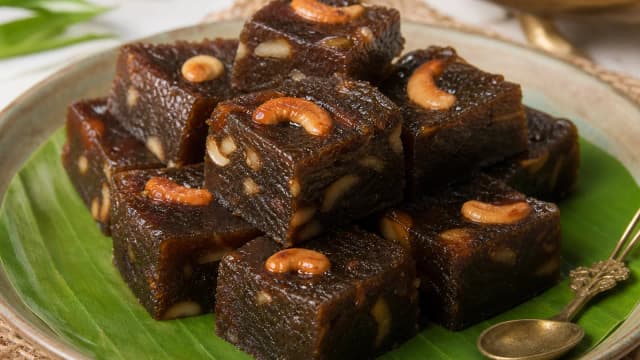
Kalu dodol is the black coconut sweet, and yes, it earns the name. Thick coconut milk, kithul jaggery and rice flour go into a pan and cook down low and slow for a couple of hours. You stir the whole time, no stopping, until the coconut oil separates out and the mass turns dark, glossy and almost black. It's dense, chewy and deeply caramelised, like toffee with warm cardamom and little nuggets of cashew. Kalu means black, and the colour is your reward for patience. You don't make kalu dodol from a recipe so much as from an hour or two of steady stirring until it tells you it's done.

Also in our Southern collection.
The New Year table sweet that goes dark, glossy and fudge-like: thick coconut milk and kithul jaggery cooked down for hours until the oil separates and it turns black.
- Total time
- 145 min
- 25 min prep · 120 min cook
- Serves
- 24 people
- Difficulty
- Advanced
- Spice level
- Mild
- Country help
- USA · UK · AU · CA substitutes included
CeylonCooking
ceyloncooking.com/recipes/kalu-dodol
Kalu Dodol
Scan to open on your phone
Nutrition
Estimated values, per serving.
About This Dish
Kalu dodol is the sweet that takes over your kitchen for an afternoon. Once the coconut milk and jaggery hit the pan, you can't walk away. The whole thing is one long, unbroken act of stirring while the mixture slowly darkens from pale caramel to deep brown to a final, glossy black. Kalu simply means black, and dodol is the family of dense, chewy, sugar-and-coconut sweets found right across the region. This is the dark Sri Lankan one, and the colour is earned, not added. It comes from long cooking and the slow caramelising of the jaggery.
It belongs above all to Avurudu, the Sinhala and Tamil New Year in April, when it sits at the centre of the sweet table beside aluwa, kokis and kavum. But kalu dodol has a home of its own too. The southern coast, and Hambantota in particular, is so well known for it that a slab of kalu dodol is the classic thing to carry home from a journey down south. It keeps for weeks, so it travels well and gives well. A good homemade batch is something cooks are quietly proud of, because everyone knows how much stirring went into it.
What sets kalu dodol apart from lighter milk-toffees and rice-flour sweets is that you basically cook it until it fries itself. Over a couple of hours, the water in the coconut milk boils away and the mixture thickens past a paste, past a dough, until the coconut oil weeps out and pools at the edges of the pan. That moment, when the oil separates, is the whole point. It's the signal that the dodol is properly done, and it leaves the sweet glossy, rich and able to set firm and keep.
Get it right and kalu dodol is unlike anything else on the table. Dark and shining, chewy and dense, it tastes of deep toffee and toasted coconut, with cardamom lifting through it and cashew giving a soft crunch. It's a sweet that runs on patience, not skill, which is exactly why it means so much. Nobody makes kalu dodol in a hurry, and a square of it always tastes a little like the afternoon that went into it.
Kithul Jaggery and the Oil That Tells You It Is Done
Kithul jaggery gives kalu dodol its flavour and that deep, near-black colour. It is unrefined palm sugar tapped from the kithul (fishtail palm), then set into hard fudgy blocks. It has a smoky, almost molasses-like caramel note ordinary sugar can't touch. As the dodol cooks for an hour or more, the jaggery darkens steadily, taking the mixture from pale to brown to black. You grate or chop it, melt it, strain out the grit it always carries, and it does two jobs: sweetens the dodol and colours it. If kithul is hard to find, other jaggery, palm sugar or even dark brown sugar will stand in, though the flavour reads a touch lighter.
The other moment that actually matters is when the oil separates, or what cooks call the dodol coming together. Thick coconut milk is mostly fat held in water. Over the long slow cook, that water boils off until the mix can't hold the fat anymore. Clear coconut oil starts to weep out and pool at the pan edges. That's not a fault. It's the finish line. Oil separating means the dodol is fully cooked, glossy and ready to set. It's the one sign every kalu dodol cook watches for. Pull the pan off before that point and the dodol stays soft and won't set. Cook it to the oil and it firms into the dense, sliceable sweet that keeps for weeks.
What It Should Taste Like
You want it dark, glossy, almost black. Dense and chewy, not soft. The flavour should be deep toffee and toasted coconut from the slow-caramelised kithul jaggery, with a faint cardamom lift and little pockets of cashew. A good slice holds its shape, with a thin sheen of coconut oil on top. Grainy is wrong. Burnt-bitter is wrong. If it won't hold a clean square, it's underdone.
Ingredients
This recipe makes 24 servings. Change the number and every amount below updates with it. Substitutes for hard-to-find items are in the sidebar.
The US button converts grams, millilitres and centimetres to ounces, cups and inches. Spoon measures stay exactly as they are.
Open this in the recipe converter
- Thick coconut milkAbout 2 tins full-fat coconut milk, or the first extract of 2 large coconuts.800 ml
- Thin coconut milk or waterThe second extract, for the rice flour slurry.400 ml
- Raw rice flourFine white rice flour, not roasted.250 g
- Kithul jaggeryGrated or chopped, or use jaggery or palm sugar.500 g
- Cashew nutsHalved.100 g
- CardamomGround, from about 10 pods.1 tsp
- Salt½ tsp
- SugarOptional, just to adjust the sweetness.100 g
- Sesame seedsOptional, to finish.1 tbsp
Method
Follow these 7 steps. Each one explains not just what to do, but why it matters.
Ready to Start Cooking?
The screen shows one step at a time, with just the ingredients that step needs at your serving count, a timer you can tap, and your phone kept awake.
- 01
Mix a Smooth Rice Flour Slurry
Whisk the rice flour into the thin coconut milk or water until it's completely smooth and there are no lumps. Then pass the whole lot through a sieve into a jug.
Look, lumps are the one thing you can't fix later, so sort them out now. Rice flour clumps the second it hits liquid. Any lump that survives into the pan will cook into a hard little knot in the finished dodol. Add the liquid to the flour a bit at a time and whisk to a thin, pourable cream. Then push it through a sieve to catch anything you missed. It should look like single cream and pour without a single speck. Those two quiet minutes at the start are what keep the dodol smooth through the long cook ahead.

Tip: Use cool liquid, not warm, to mix the flour. Warm liquid starts to cook the starch and makes it claggy and harder to smooth out.
- 02
Melt and Strain the Jaggery
Break the kithul jaggery into a small pan with a splash of coconut milk or water. Warm it gently until it melts into a syrup, then strain it to get rid of any grit.
Jaggery is unrefined, so almost every block carries a bit of sand, husk or sediment from how it is made. You don't want that grinding between your teeth in the finished sweet. Melt it slowly with a little liquid and it loosens into a dark, pourable syrup. A quick pass through a sieve or muslin leaves only clean, smoky-sweet jaggery behind. Take a second to smell it. That deep, molasses-like syrup is where most of the colour and nearly all of the character of kalu dodol comes from.

Tip: Keep the heat low while it melts. Jaggery scorches easily, and burnt jaggery turns the whole batch bitter before you've even begun.
- 03
Combine Everything in a Heavy Pan
Pour the rice flour slurry, the strained jaggery syrup, the thick coconut milk and the salt into a wide, heavy-bottomed pan. Stir to combine, then bring it to a gentle simmer over medium heat, stirring all the while.
The pan matters more here than nearly anything else. Kalu dodol cooks long and thickens into a heavy mass. A thin, light pan gets scorching hot spots that burn the dodol from underneath. Pick the heaviest, widest pan you own. Extra surface area helps the water evaporate, and the weight spreads the heat evenly. When everything warms and the first bubbles rise, the mixture will be thin and milky, pale brown from the jaggery. That is the calm before the work. From here on, the spoon doesn't stop.

Tip: A wide pan beats a tall one here. More surface area means the water boils off faster, and the dodol comes together sooner.
- 04
Stir, and Keep Stirring, as It Darkens
Lower the heat and cook for around 1 to 1.5 hours, stirring constantly and scraping the base. It thickens from thin milk to paste to a heavy, pulling dough, while the colour deepens from pale caramel to deep brown.
This is the long heart of kalu dodol, and the rule is simple: never stop stirring. As the water cooks away, the mixture passes through every stage of thickness. First it is like custard, then a loose porridge, then a sticky paste that clings to the spoon. The colour deepens with it, from milky beige to caramel to a rich, dark brown. The bottom of the pan is where it will catch, so keep the spoon moving in slow figure-eights right across the base. It's slow, physical work, and an extra pair of hands to take a turn is the traditional way. Do not rush it with high heat. Gentle and steady is what builds that deep, even, toffee flavour.

Tip: Use a long, sturdy wooden spoon or paddle, and keep your hand and arm clear. Once the dodol thickens, it bubbles thickly and spits like very hot toffee.
- 05
Cook to the Oil Separation
Keep cooking and stirring until the mass turns dark, glossy and almost black, pulls away from the sides of the pan in one piece, and clear coconut oil weeps out and pools at the edges. Stir in the cashews and cardamom in the last few minutes.
This is the moment the whole afternoon has been building to. Once the mixture has reduced to a thick, heavy dough, the surface starts to shine and small pools of clear oil appear at the edges and on top. That separated oil is your signal that kalu dodol is properly done. The coconut fat has been pushed out, and the dodol is basically frying gently in its own oil. The mass will be very thick and glossy, almost black, and will come away from the pan as a single lump when you push it. Fold in the cashews and cardamom now so they spread evenly through the finished sweet. If you pull it off before the oil shows, it will stay soft and never set.

Tip: Don't panic at the oil. It's the goal, not a mistake. A dodol that has reached the oil stage is the one that will set firm, slice cleanly and keep for weeks.
- 06
Press It into a Greased Tray
Work quickly while it's hot and pliable. Scrape the dodol into a greased or lined tray and press it into an even slab about 2 cm thick. Smooth the top, then scatter over the sesame seeds and a few extra cashews.
Hot dodol stiffens as it cools, so move without dawdling. Tip the whole glossy mass into your tray and press it flat with the back of a greased spoon or oiled hands, pushing it well into the corners so it sets in one solid slab. A thin film of separated coconut oil on top is a good thing, not a flaw. It gives the dodol its sheen and helps it keep. The surface should look dark, glossy and faintly oily, like polished toffee.

Tip: Grease the tray and your spoon or hands generously. Kalu dodol is intensely sticky while it is warm. If anything it touches is dry, it pulls and tears.
- 07
Cool Fully, Then Cut
Leave the slab to cool completely and firm up. Ideally give it several hours or overnight. Then cut it into small squares or diamonds with a clean knife that you have lightly oiled.
Kalu dodol sets as it cools, so the patience at the end matters just as much as the patience at the stove. As it cools, the oils and caramelised sugars firm into a dense, chewy slab that holds a clean edge. That clean edge is why a properly cooked batch slices into neat squares instead of smearing. Let it go completely cold and set undisturbed. Then cut it into small pieces, because it is very rich and a little goes a long way. Wipe and re-oil the knife between cuts for clean edges. This sweet is so dense and sugary that it keeps for weeks. That is why people make it in big trays for the New Year and to give away.

Tip: If the cooled dodol is still soft and sticky and won't hold a square, it did not cook quite to the oil stage. Tip it back into the pan and cook it a little longer next time.
Common Mistakes to Avoid
- Using a thin, light pan means the dodol scorches in hot spots and the whole batch tastes burnt.
- Stopping stirring, even for a minute, lets it catch on the base and turns it bitter.
- Rushing it on high heat instead of cooking low and slow burns the outside before the inside reduces.
- Pulling it off the heat before the coconut oil separates means it never sets and stays soft and sticky.
- Not sieving the rice flour slurry leaves hard lumps cooked through the finished sweet.
- Not straining the jaggery lets grit and sediment end up in the dodol.
- Cutting it before it has fully cooled and set means the pieces smear instead of slicing clean.
Serving Ideas
- On the Avurudu sweet table, beside aluwa, kokis and kavum.
- Cut into small squares with a cup of plain tea, milk tea or coffee.
- As a rich after-dinner sweet, where a single small piece is plenty.
- Boxed up in neat squares as a homemade gift, since it keeps for weeks.
- Wrapped to carry on a journey, the way it is traditionally bought along the southern coast.
Building a whole plate around it? Start from our sri lankan party menu menu, which sets out what to cook alongside it and in what order.
Storage and Make-Ahead
Kalu dodol keeps remarkably well because of all that sugar and coconut oil. In an airtight container at room temperature it stays good for about 2 to 3 weeks. In the fridge it lasts longer, a month or more, but it firms up cold, so let it come back to room temperature before serving. Keep it covered so the surface does not dry out. Cut only what you need and leave the rest as a slab. That faint sheen of oil on top helps preserve it, so do not wipe it away. There is no need to freeze it.
Two Ways to Cook It
For a smaller batch, use tinned full-fat coconut milk and ready-melted kithul treacle or grated jaggery. Cook it in a heavy non-stick pan so the constant stirring feels easier. Keep the heat low and share the stirring with someone. Just keep going until the mixture turns dark, pulls into one mass and the oil clearly separates. Then press and cool. It is long but not difficult.
Scrape the coconut yourself and squeeze your own milk, first thick and then thin. Sweeten with real kithul jaggery or kithul pani. Cook in a wide, heavy pan over a low, steady heat, stirring without stopping for two hours or more, until the oil separates and the dodol turns glossy black. That's how it's made along the southern coast and in Hambantota.
Lighter and Healthier Version
Kalu dodol is rich, full stop. It's coconut and jaggery cooked down into a festive sweet, so there's only so far you can lighten it before it stops being kalu dodol. The honest move is to keep it true, treat it as the treat it is, and make a few small choices that help.
Cut Small Squares
It's dense and concentrated. Cut it into small squares and let one piece do the job. Portion size is the simplest way to keep this a treat.
Lean on the Jaggery
Skip the optional extra sugar and let the kithul jaggery carry all the sweetness. It's deeply flavoured, so you get the richness with less added refined sugar.
Naturally Dairy-Free and Vegan
Kalu dodol is coconut milk, jaggery, rice flour, nuts and spice, so there's no dairy and no animal products in it. That makes it vegan and dairy-free as it is.
Naturally Gluten-Free
Rice flour is the only flour in kalu dodol, so it's naturally gluten-free. If you're highly sensitive, just check that your rice flour wasn't milled alongside wheat.
Frequently Asked Questions
Kalu dodol is a traditional Sri Lankan sweet. You cook thick coconut milk, kithul jaggery and rice flour together very slowly, stirring constantly for a couple of hours, until the coconut oil separates out and the mix turns dark, glossy and almost black. It ends up dense and chewy, deeply caramelised, tasting of toffee and coconut with cardamom and cashew. It's a fixture of the New Year sweet table.
Cooked It? Tell Us How It Went
Your notes on this kalu dodol help the next person get it right: what you swapped, what you would do differently, where the recipe should have warned you. Tap a star if you are in a hurry, or write a few lines if you have a minute.
You Might Also Like


Sri Lankan Home Cooking Starter Pack
40 authentic Ceylon recipes made simple for foreign kitchens: spice guide, pantry checklist, substitute guide, 7-day meal plan and printable shopping lists.