Konda Kavum
Sri Lankan Kavum (Oil Cake)
Also known as Sri Lankan Oil Cake
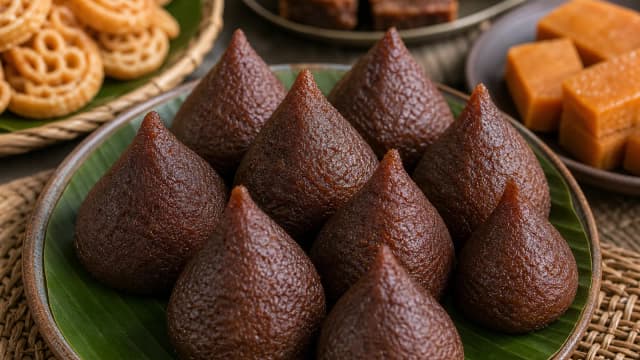
Sri Lankan kavum, known as konda kavum and in English as oil cake, is a small dark sweet made by spooning a thick batter of roasted rice flour and kithul treacle into hot oil and coaxing it into a single pointed peak, the konda. Dense, sticky-sweet and deeply traditional, this oil cake is the heart of the Sinhala and Tamil New Year table, where the peak crowning each cake is a quiet point of pride.

The dark, pointed-peak oil cake of the New Year table. Sticky, treacle-sweet and the proudest little sweet a Sri Lankan cook can coax out of a pot of hot oil.
- Total time
- 60 min
- 30 min prep · 30 min cook
- Serves
- 16 people
- Difficulty
- Advanced
- Spice level
- Mild
- Country help
- USA · UK · AU · CA substitutes included
CeylonCooking
ceyloncooking.com/recipes/kavum
Sri Lankan Kavum (Konda Kavum)
Scan to open on your phone
Nutrition
Estimated values, per serving.
About This Dish
Walk into a Sri Lankan kitchen in the days before Avurudu and you'll find someone bent over a pot of hot oil, a skewer in one hand, coaxing dark little cakes into shape one at a time. This is kavum, the oil cake, and the full name konda kavum points to the thing that makes it special: the konda, the single pointed peak that rises from the centre of each cake like a topknot. A kavum without its konda is just a fried lump. A kavum with a clean, proud peak is the work of a cook who knows what they're doing.
Kavum is New Year food before it's anything else. As the old year turns to the new, the table fills with sweets made from rice, treacle and coconut, and kavum sits right at the centre alongside kokis, aluwa and asmi. There's meaning in it beyond flavour: a plate of well-made kavum is a sign of a prosperous, blessed household, and the first batch is often made at the auspicious time, with the whole family gathered around the oil pot. Children learn the konda by watching, then by burning a few, then finally by getting one to stand tall.
The batter itself is simple and ancient: roasted rice flour and treacle, loosened to a thick dropping consistency, sometimes scented with a little salt, scraped coconut or a whisper of spice. The magic is all in the hand and the heat. The batter has to be thick enough to hold together yet loose enough to swell. The oil has to be hot enough to set the outside fast. The skewer has to be patient enough to gather the rising batter into one neat peak instead of letting it sprawl. Get those three in balance and the cake darkens, the peak forms, and you lift out something that looks almost impossible to have made from a spoonful of paste.
What you're after at the end is a cake that's deeply dark and a little crisp outside, dense and treacle-soft inside, sweet but not cloying, with that smoky kithul depth running through every bite. It keeps for days in a tin, travels well in a New Year gift box, and it tastes of celebration in a way few sweets do. Mastering the konda takes practice, but every cook who has stood at that pot will tell you the first one that stands up straight feels like a small victory.
Roasted Rice Flour and Kithul Treacle: Why Both Matter
Kavum lives or dies on two ingredients, and neither is the kind you grab without thinking. The first one is roasted rice flour. Plain raw rice flour makes a slack, pasty batter that fries gummy and refuses to hold a peak, so you dry-roast the flour first until it smells nutty and turns the faintest shade darker. Roasting drives off moisture and changes how the starch behaves, giving the batter body and that characteristic dense, almost chewy crumb. Many cooks buy flour already labelled for kavum or hoppers, but a few minutes in a dry pan over low heat will wake up ordinary rice flour too.
The second piece is the sweetener, and kithul treacle and jaggery are cousins, not twins. Kithul treacle, or kithul pani, is the thick dark syrup tapped from the fishtail palm, with a smoky, almost molasses-deep flavour that is the soul of an authentic kavum. Jaggery is that same sap boiled down until it firms into blocks, so melted back into syrup it does much the same job and is easier to find. Treacle goes straight into the batter and gives a softer, glossier cake. Jaggery syrup sits a touch firmer and needs melting first. Either way, the dark unrefined sugar is what gives kavum its colour and character. Plain white sugar cannot stand in for it.
What It Should Taste Like
Deeply dark, lightly crisp on the outside, dense and treacle-soft inside, sweet but rounded rather than sugary, with that smoky kithul depth running all the way through. Each cake should feel sticky and substantial, and a clean pointed peak sits up on top.
Ingredients
This recipe makes 16 servings. Change the number and every amount below updates with it. Substitutes for hard-to-find items are in the sidebar.
The US button converts grams, millilitres and centimetres to ounces, cups and inches. Spoon measures stay exactly as they are.
Open this in the recipe converter
For the Batter
- Roasted rice flourRice flour, dry-roasted until it smells nutty, then cooled.2 cups
- Kithul treacleOr use 1 cup thick jaggery syrup instead.1 cup
- Thick coconut milkJust enough to loosen the batter.2 to 3 tbsp
- Salta pinch
- Scraped coconutOptional, and lightly toasted if you use it.2 tbsp
- CardamomGround, if you like.a pinch
For Frying
- Coconut oil or neutral oilEnough for the cakes to float freely.for deep frying
Method
Follow these 8 steps. Each one explains not just what to do, but why it matters.
Ready to Start Cooking?
The screen shows one step at a time, with just the ingredients that step needs at your serving count, a timer you can tap, and your phone kept awake.
- 01
Roast the Rice Flour
If your rice flour has not been roasted already, dry-roast it in a wide pan over low heat. Stir constantly until it smells nutty and shifts a shade off-white, then tip it onto a plate to cool completely.
This is the quiet groundwork that decides whether your kavum keeps a peak or slumps into a puddle. Raw rice flour is damp and full of slack starch. Roasting drives that water off and tightens the starch so the batter sets with body instead of spreading. Keep the heat low and keep the spoon moving, because rice flour scorches fast and even a faint burnt note will haunt the whole batch. You are not browning it, just waking it up: the smell shifts from raw and dusty to warm and toasty, and the colour barely changes. Let it cool completely before mixing, or the residual heat starts cooking the treacle unevenly.

Tip: Roast extra and keep it in a jar. Cooled roasted rice flour keeps for weeks, and it's exactly the thing to have on hand for hoppers and other sweets.
- 02
Warm the Treacle (or Melt the Jaggery)
Warm the kithul treacle gently in a small pan until it turns loose and pourable. If you are using jaggery, grate it and melt it with a splash of water over low heat, then strain out any grit and let it cool to barely warm.
The sweetener is the heart of the batter, so treat it gently. Kithul treacle only needs a little warmth to pour cleanly. Push it too far and it tightens and turns bitter at the edges. Jaggery takes more coaxing because it sets hard. It melts down with a splash of water into a dark syrup that smells of toffee and smoke, and straining catches the fine fibre and stray nibs that never dissolve. Whichever you use, let it cool to barely warm before it meets the flour. Pour it in piping hot and it will cook the flour into lumps on contact and rob the batter of its smooth, glossy body.

Tip: Taste the warmed treacle. If it runs thin and very sweet, you'll need a little less liquid later. If it is thick and intense, the batter will come together faster.
- 03
Mix the Batter
Put the cooled roasted rice flour, salt and any cardamom or toasted coconut in a bowl. Pour in the treacle a little at a time, mixing with your hand, until you have a thick, smooth batter that drops slowly off the spoon. Loosen it with a little coconut milk only if it is too stiff.
This is the make-or-break consistency, and it's best judged by hand rather than by exact measurement, because flours and treacles vary. You want a batter thick enough to mound, not pour. When you lift a spoonful it should fall in a slow, heavy ribbon and settle instead of running. Too thin, and the cake spreads flat and never builds a peak. Too thick, and it fries dense and refuses to swell and gather. Add the liquid gradually and stop the moment it feels right. The batter should be glossy and smooth, with no dry pockets of flour and no slack puddle at the bottom of the bowl.

Tip: Drop a small test spoonful onto a plate. If it holds a soft mound and slowly relaxes, you're good. If it flattens immediately, work in a little more roasted flour.
- 04
Rest the Batter
Cover the batter and let it rest for 20 to 30 minutes. That gives the rice flour time to fully absorb the treacle and the mixture firms up.
Resting is the step impatient cooks skip, and then they wonder why their kavum won't behave. As the batter sits, the roasted flour drinks in the treacle and swells. The mixture thickens and steadies into something that holds its shape the instant it hits the oil. A freshly mixed batter is often deceptively loose. Give it half an hour and it tightens into the proper moundable consistency. This pause is also your last chance to adjust. Check the texture again after resting, because it will be a touch thicker than when you mixed it.

Tip: Rest it covered at room temperature, not in the fridge. Cold batter goes stiff and unevenly thick, and it's much harder to coax into a peak.
- 05
Heat the Oil
Heat a deep pan of oil over medium heat until a tiny drop of batter sizzles gently and rises to the surface without browning instantly.
The oil temperature is the third thing that has to be right, alongside the batter and your hand. Too cool and the cake drinks oil, spreads and turns greasy and pale. Too hot and the outside darkens and seizes before the inside cooks or the peak has time to form. You want a steady medium heat where a test drop sinks, then floats up within a couple of seconds with a soft, even sizzle and only gradual colour. A deep pan matters because the cakes need room to float and to be turned, and deep oil holds its temperature more evenly than a shallow layer that swings hot and cold with every cake you add.

Tip: Always test with a single drop of batter before you commit to a whole spoonful. Adjust the flame and test again until the sizzle is gentle and steady, not violent.
- 06
Spoon in the Batter and Coax the Peak
Lower a heaped spoonful of batter into the hot oil so it sits as a neat mound. As it begins to swell and set, slip a skewer or chopstick into the centre. Gently gather the rising batter upward, holding it together so a single pointed peak, the konda, forms.
This is the moment the whole dish is named for, and it rewards a patient hand. As the spoonful hits the oil it puffs and the surface starts to firm. That's your cue to bring in the skewer. Touch it into the centre and lift and gather the soft batter inward and upward, coaxing the cake to rise into one tidy peak rather than spreading into a flat disc. Keep turning the skewer slowly so the peak builds evenly and does not topple. The cake will fight you at first and may slump back, which is normal. A few gentle gathers as it sets is all it takes. Don't crowd the pan, because each cake needs space and your full attention for those first crucial seconds.

Tip: Look, practise the wrist motion on your first cake and accept it may be ugly. The konda is muscle memory. By the third or fourth cake your hand will know exactly when to gather.
- 07
Fry Until Dark and Cooked Through
Let the cake fry gently, turning now and then, until it's deep dark brown all over and cooked through to the centre. Give it several minutes per cake.
Kavum is meant to be properly dark, far darker than most fried sweets. That deep colour is where the treacle flavour concentrates, and the cake is named for it. Turn each one gently with the skewer or a slotted spoon so every side, peak included, colours evenly. Don't pull them out early: a pale kavum is raw and gummy in the middle and tastes flat. Fried long and slow at a steady medium heat, it turns dense, treacly and rich right to the core. The peak cooks fastest, so keep nudging the cake so the konda doesn't scorch while the body finishes.

Tip: Break open your first cake to check the centre. It should be set and treacle-dark all the way through, not pasty or pale in the middle. Adjust your timing for the rest of the batch.
- 08
Drain and Cool
Lift each kavum out, letting the excess oil drip back into the pan, then rest them on a rack or kitchen paper to drain. Let them cool completely before storing.
How you drain decides whether the cake is sticky-rich or heavily greasy. Hold each one over the pan for a moment so the loose oil runs off, then set it on a rack. Air circulates underneath and the surface firms rather than sweating against a flat plate. As they cool the cakes settle, the inside turns denser and chewier, and the flavour rounds out. A just-fried kavum and a fully cooled one taste noticeably different. Cool them completely before they go into a tin: trapped warmth turns to steam and makes them go soft and lose their slight crispness.

Tip: A wire rack beats kitchen paper for draining. Paper can trap oil against the base and leave it soggy on one side.
Common Mistakes to Avoid
- Using raw rice flour instead of roasted. The batter goes slack, the cake fries gummy and won't hold a peak.
- Getting the batter consistency wrong: too thin spreads into a flat disc, too thick fries dense and refuses to swell into a konda.
- Skipping the rest. The batter hasn't firmed up, so the cakes lose their shape the moment they hit the oil.
- Frying in oil that's too hot. It darkens and seizes the outside before the peak forms or the centre cooks.
- Frying in oil that's too cool. The cakes drink oil, spread and turn greasy and pale instead of dark and dense.
- Pulling the cakes out too early. They stay raw and pasty in the middle rather than treacle-dark all the way through.
- Pouring hot treacle or jaggery syrup straight onto the flour. It cooks into lumps and ruins the smooth batter.
Serving Ideas
- Piled on a plate as part of the New Year sweet table alongside kokis, aluwa and asmi.
- With a cup of strong, unsweetened Ceylon tea to balance the sweetness.
- Tucked into a New Year gift box of homemade sweets to share with neighbours and family.
- Serve at room temperature as a sticky-sweet snack, any time of year.
- Serve it with kiribath at an auspicious-time breakfast when you're marking a celebration.
Building a whole plate around it? Start from our sri lankan party menu menu, which sets out what to cook alongside it and in what order.
Storage and Make-Ahead
Cooled kavum keeps for up to a week in an airtight tin at room temperature. That dense, treacly texture holds up well over those days. Make sure the cakes are completely cool and well drained before they go in, or trapped warmth and oil will turn them soft. Keep the tin out of direct heat and humidity. They don't need refrigerating, and chilling tends to harden them. If you do refrigerate, bring them back to room temperature before serving. For longer storage, they freeze for up to a month in a sealed container, thawed at room temperature.
Two Ways to Cook It
Reach for ready-roasted rice flour and bottled kithul treacle, that way you skip the roasting and melting. Keep the batter slightly thick, it's more forgiving. Don't sweat a perfect konda on your first batch. Fry a little hotter than a confident cook would, and just aim for dark, well-cooked cakes. The peak comes with practice.
Dry-roast the rice flour yourself, use real kithul treacle for that smoky depth, and scent the batter with a little toasted scraped coconut and ground cardamom. Fry in coconut oil. Coax a clean, tall konda on each cake with a skewer and fry them properly dark, the way they're made at the auspicious time for the New Year table.
Lighter and Healthier Version
Kavum is deep-fried and festive, so it's never going to be a light food. Still, a few small changes keep it a little less rich without dropping the treacly character that makes it kavum. Most of the calories come from the frying oil and the treacle, so that's where there's room to ease back.
Drain Thoroughly
Drain each cake on a wire rack, not a plate, so air moves underneath and far less oil clings to the base. Well-drained kavum carries noticeably less fat per cake.
Keep the Oil at the Right Heat
Fry at a steady medium heat. Oil that's too cool is the main reason kavum turns greasy. The cakes sit and soak it up instead of sealing quickly.
Make Them Smaller
Spoon in smaller portions of batter for petite cakes. A little kavum is satisfying, and smaller cakes fry faster and absorb proportionally less oil.
Ease off the Treacle
Pull back the treacle a little. The roasted flour and coconut still carry the flavour, and the cakes stay dark and sticky without being quite so intensely sweet.
Serve with Unsweetened Tea
Pair kavum with plain, strong Ceylon tea, not a sweet drink, so the sweetness of one cake is plenty and you're less tempted to reach for a third.
Frequently Asked Questions
Kavum is a traditional Sri Lankan sweet, an oil cake made by spooning a thick batter of roasted rice flour and kithul treacle into hot oil and frying it dark. It's dense, sticky-sweet and smoky from the treacle, and it's one of the central sweets on the Sinhala and Tamil New Year (Avurudu) table.
Cooked It? Tell Us How It Went
Your notes on this sri lankan kavum help the next person get it right: what you swapped, what you would do differently, where the recipe should have warned you. Tap a star if you are in a hurry, or write a few lines if you have a minute.
You Might Also Like


Sri Lankan Home Cooking Starter Pack
40 authentic Ceylon recipes made simple for foreign kitchens: spice guide, pantry checklist, substitute guide, 7-day meal plan and printable shopping lists.