Annasi Dosi
Sri Lankan Pineapple Dosi (Candied Pineapple)
Also known as Pineapple Preserve
Pineapple dosi, or annasi dosi, is a Sri Lankan candied fruit sweet: chunks of slightly under-ripe pineapple simmered slowly in a sugar syrup until they turn glossy and almost translucent, scented with roasted cardamom. It is a fixture on festive tables, especially at Eid and at weddings, and it is one of those old home-made sweets that needs only four things: pineapple, sugar, water and cardamom. Made properly it keeps for months in a jar in the fridge, so most people cook a batch ahead of the day rather than on it.

Also in our Muslim Sri Lankan collection.
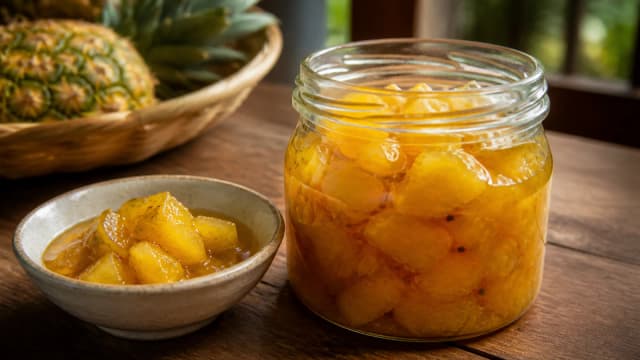
Glossy candied pineapple in a honey-thick cardamom syrup. A festive sweet that keeps for months in the fridge.
- Total time
- 60 min
- 20 min prep · 40 min cook
- Serves
- 12 people
- Difficulty
- Medium
- Spice level
- Mild
- Country help
- USA · UK · AU · CA substitutes included
CeylonCooking
ceyloncooking.com/recipes/pineapple-dosi
Sri Lankan Pineapple Dosi (Annasi Dosi)
Scan to open on your phone
Nutrition
Estimated values, per serving.
About This Dish
Dosi is the family of Sri Lankan sweets where fruit is cooked slowly in sugar until it candies, and pineapple is the one everybody knows. The fruit goes in raw and firm and comes out amber, glassy and heavy with syrup, sweet the whole way through but still tasting clearly of pineapple. You will also see it written anasi dosi, and both names point at the same thing: annasi is pineapple in Sinhala, and the dosi is what the sugar does to it.
It belongs to festivals. Sri Lankan Muslim homes make it for Eid, where it sits on the table beside the other home-made sweets and gets spooned out to everyone who calls in, and it turns up at weddings and almsgivings too. The making is deliberate and unhurried, usually a day or two ahead, because the whole point is that a jar of it waits in the fridge until the guests arrive. Nobody makes a small batch.
For something with four ingredients, it asks for a bit of judgement. Almost everything that decides whether yours comes out well happens before the pan gets hot: picking fruit that is only just ripe, cutting it into chunks that hold together, keeping the core, then pricking the pieces and squeezing them so the syrup has somewhere to go. Cook a soft, sweet, fully ripe pineapple and it falls apart into jam. Cook a firm one and it stays in pieces you can lift out with a fork.
The rest is patience and one moment of attention. It simmers quietly for over half an hour while you leave it alone, and then quite suddenly the syrup thickens and the fruit turns from opaque to glassy. That is the point to take the pan off the heat, and a minute past it the syrup starts to crystallise as it cools. Get that moment right and you have a jar of the most familiar festive sweet on the island.
Picking the Right Pineapple
The fruit does most of the work here, so choose it carefully. You want a pineapple that is only just ripe: skin turning golden yellow but still with a tinge of green here and there, firm to the squeeze, smelling sweet only faintly at the base. A fully ripe pineapple is lovely to eat raw and wrong for dosi. Its flesh is already soft and full of juice, so it slumps in the syrup and you end up with sweet pulp rather than chunks.
Keep the core. It looks like the tough part you would normally cut away, but in dosi it is the piece that holds a chunk together through 35 minutes of simmering, and it candies into the firm, chewy centre people look for. Trim only the sharp point where the core meets the outside of the wedge. Everything else stays. Tinned pineapple cannot do any of this, since it has already been cooked soft in syrup and it disintegrates within minutes.
What It Should Taste Like
Very sweet, but not flat: the pineapple keeps enough of its own sharpness to cut through the syrup, and roasted cardamom sits warm behind it. The texture is the point. The outside is glossy and yielding, the core stays firm and chewy, and the syrup clinging to each piece should be thick enough to coat a spoon rather than run off it.
Ingredients
This recipe makes 12 servings. Change the number and every amount below updates with it. Substitutes for hard-to-find items are in the sidebar.
The US button converts grams, millilitres and centimetres to ounces, cups and inches. Spoon measures stay exactly as they are.
Open this in the recipe converter
- Pineappleabout 1 kg whole, only just ripe: golden with a tinge of green, still firm1 medium
- White sugarabout 2 1/2 cups480 g
- Waterabout 1 1/2 cups, plus 125 ml more if the fruit is very firm375 ml
- Roasted cardamomor 4 pods, lightly crushed1/2 tsp ground
- Caramelised sugaroptional, only if you want a darker dosi1 tbsp
Method
Nearly all the skill is in the first three steps, which are about the fruit rather than the pan. The cooking itself is a slow simmer you mostly leave alone, plus one moment at the end where you have to be watching.
Ready to Start Cooking?
The screen shows one step at a time, with just the ingredients that step needs at your serving count, a timer you can tap, and your phone kept awake.
- 01
Peel the Pineapple Properly
Cut off the top and base, slice the skin away down the sides, then go back and dig out every one of the little brown eyes left behind in the flesh.
The eyes are the part people rush and regret. They are woody and they stay woody no matter how long the fruit simmers, so a chunk with an eye still in it has a hard, fibrous bite in the middle of all that soft candied fruit. Take them out with the tip of a knife, or cut diagonal grooves along the rows the way they naturally spiral around the fruit, which wastes less flesh than peeling deeper.

Tip: Work over a bowl. There is a surprising amount of juice in the trimmings and it is worth keeping.
- 02
Cut It into Chunks, Core and All
Halve the pineapple lengthways, then cut each half into wedges, neither thin nor thick. Trim only the sharp point of the core on each wedge, then cut the wedges across into similar-sized chunks.
Keeping the core is what makes this dosi rather than jam. Each wedge needs that firm spine running through it or it collapses in the syrup, so resist the instinct to cut it out and take off no more than the sharp tip. Cut everything to roughly the same size, since a pan of mixed pieces cooks unevenly and the small ones go to mush while the big ones are still raw in the middle. Thin slices are the other trap: they lose their shape almost immediately.

Tip: Larger chunks hold up better and look better in the jar. Halve or third the wedges, nothing smaller.
- 03
Prick the Pieces and Squeeze the Juice Out
Lay the chunks on a board and prick them all over with a fork, going at the core end hardest and the soft base more lightly. Then squeeze each piece gently over a cup to press out the juice, and set the squeezed pieces aside.
This is the step that separates a good dosi from a watery one, and it does two jobs at once. The fork holes open channels for the syrup to travel into, so the sugar reaches the middle of each chunk instead of just glazing the outside. Squeezing pushes out the fruit's own juice, which would otherwise leak into the pan and thin the syrup, leaving you simmering for ages to drive the water off again. Squeeze firmly enough to see the juice run, gently enough that the chunk keeps its shape. Keep the juice, chill it and drink it. It is the cook's reward.

Tip: The core end needs the most pricking, since it is the densest part and the last to take up any syrup.
- 04
Dissolve the Sugar
Put the sugar and water in a wide non-stick pan over medium heat and stir until the sugar has dissolved completely. You are not looking for any particular syrup stage yet, just clear liquid with no grains left.
Non-stick matters here. A sugar syrup this heavy catches on bare metal towards the end, and once one patch scorches the whole batch tastes of it. Use a wide pan rather than a deep one so the fruit sits in a single layer with room around it. Undissolved grains are the other thing to watch: any sugar still sitting on the base when the fruit goes in can seed crystals later, so run a spoon through it and check before you go on.

Tip: If your pineapple is very firm, add the extra 125 ml of water now. It gives the fruit longer to soften before the syrup thickens.
- 05
Slide the Fruit in and Simmer, Without Stirring
Lower the chunks gently into the syrup, turn the heat down to a low simmer, and leave them to cook for 30 to 40 minutes. Do not stir them.
Stirring is what breaks the pieces up, and it is a hard habit to resist for half an hour. Left alone, the fruit slowly gives up its firmness while the syrup works its way in through the fork holes, and the chunks take on a pale golden tinge from the bottom up. A low flame is essential: at a rolling boil the syrup thickens long before the fruit is tender, and you end up with hard pineapple in heavy syrup. If you must move things, tilt and swirl the whole pan rather than putting a spoon in.

Tip: Keep the lid off throughout. This is a preserve, so the water has to leave the pan.
- 06
Add the Cardamom Around the 20 Minute Mark
Once the fruit has been simmering for about 20 minutes, scatter in the roasted cardamom. Stir in the caramelised sugar now too if you want a deeper colour.
Cardamom goes in late on purpose. Its scent is volatile and half an hour over a flame flattens it, so adding it towards the end keeps it bright in the finished jar. Roasted cardamom, ground fresh, gives the warmest flavour, though lightly crushed pods work too and can be left in or fished out as you prefer. The dosi's natural colour at this stage is a pale gold. Some cooks want the darker amber you see on festive tables, and a spoon of caramelised sugar is how they get it.

Tip: Grind the cardamom just before it goes in. Pre-ground powder that has sat in a jar for months has very little left to give.
- 07
Cook to the Honey Stage and Take It Straight Off
Keep the heat low to medium and watch the syrup from about 30 minutes. It is ready when the pineapple looks glossy and almost see-through and the syrup has thickened to about the consistency of honey. Take the pan off the heat at once.
This is the one moment that decides the batch, and it arrives quickly after a long, uneventful simmer. The visual cue is the fruit turning from opaque yellow to translucent amber, and the syrup cue is thickness: lift the spoon and it should fall in a thick, slow ribbon rather than run off like water. The instant it gets there, pull the pan off, because a heavy syrup keeps cooking in the pan's own heat and a syrup taken too far crystallises into a grainy, sugary mess as it cools. Under-cooking is much easier to fix than over-cooking, so err early and put it back for another two minutes if you need to.

Tip: Take the pan right off the hob, not just off the flame. A hot ring underneath is enough to carry it past the point.
- 08
Cool It in the Pan, Then Bottle It
Leave the dosi to cool completely in the pan, without moving it about. Then spoon the fruit and syrup into a thoroughly dry glass jar and keep it in the fridge.
Cooling in the pan lets the chunks go on soaking up syrup as the temperature drops, which is where the last of the gloss comes from. Bottling while hot is a mistake twice over: the steam condenses inside the lid and drips water back into a preserve that depends on having none, and the soft, warm pieces break as you move them. The jar has to be properly dry, ideally washed and left in the sun or a low oven until there is no trace of moisture anywhere inside it. Any water is what turns a jar that would have kept for months into one that ferments in a fortnight.

Tip: Pack the fruit in first, then pour the syrup over until the pieces are covered. Syrup is the preservative, so nothing should sit above the line.
Common Mistakes to Avoid
- Using a fully ripe pineapple, which is already soft and collapses into pulp in the syrup.
- Cutting the core out, so the chunks have no spine and fall apart as they simmer.
- Skipping the pricking and squeezing, so the syrup never gets inside the fruit and the fruit's own juice thins the pan.
- Stirring while it cooks, which breaks the pieces up.
- Simmering too hard, so the syrup thickens before the pineapple is tender.
- Leaving the pan on the heat past the honey stage, which crystallises the syrup as it cools.
- Bottling it warm or into a jar that is not bone dry, which is what makes a batch ferment.
Serving Ideas
- On the festive table in a small bowl, eaten a piece at a time with the syrup clinging to it.
- Spooned over curd or plain yoghurt, with a little of the syrup poured on.
- With a cup of plain tea in the afternoon, when something very sweet is the point.
- Chopped small and folded through vanilla ice cream just before serving.
Building a whole plate around it? Start from our sri lankan party menu menu, which sets out what to cook alongside it and in what order.
Storage and Make-Ahead
Kept in a completely dry, airtight glass jar in the fridge, with the fruit submerged in its syrup, pineapple dosi keeps for a few months. Always lift pieces out with a clean, dry spoon, since one wet spoon is enough to spoil a jar. If the syrup crystallises around the edges over time, warm the jar gently in a bowl of hot water. If it ever smells fermented or fizzes when opened, throw it out.
Two Ways to Cook It
Buy the firmest pineapple you can find, cut it into large chunks rather than small ones so there is less to go wrong, and use the full 500 ml of water so the fruit has plenty of time to soften before the syrup thickens. Start checking the syrup at 25 minutes and pull the pan off as soon as it coats a spoon. Slightly loose dosi is a much better outcome than crystallised dosi.
Choose fruit that is only just turning, keep every bit of core, prick and squeeze each chunk by hand, and simmer it in a wide pan without stirring once. Grind roasted cardamom fresh and add it late, take the pan off the moment the syrup falls like honey, and bottle it in a jar dried in the sun. Make it two days before the festival so it has time to sit.
Lighter and Healthier Version
There is no getting around what this is: fruit preserved in sugar, and the sugar is what makes it keep. Cutting it back changes both the texture and the shelf life, so the honest lighter options are about how much you eat and how you serve it rather than reworking the recipe.
Serve It Small
One or two glossy pieces with the syrup drained off is a real portion of dosi. Treat it as something you have a little of rather than a bowl of.
Drain the Syrup
Most of the sugar you eat comes from the syrup clinging to each piece. Lift the fruit out with a fork and let it drain for a moment and you leave a good deal of it behind in the jar.
Serve It with Something Plain
Spooned over unsweetened curd or plain yoghurt, a small amount of dosi sweetens the whole bowl, so a little goes much further than it does on its own.
No Fat at All
There is nothing fried here and no coconut, butter or oil in it anywhere. What it has is sugar, so that is the only number worth watching.
Watch How to Make It
Read the steps already? Watch the whole process from start to finish, in whichever language you would rather listen in.
Choose a language
Pineapple Dosi, Start to Finish
Narrated in English
The whole method on camera: choosing and cutting the fruit, pricking and squeezing the wedges, and simmering them down to a honey-thick syrup.
Filmed by Nazeema's Taste of Home. We did not make this video, we are linking to theirs.
Watch on YouTubeFrequently Asked Questions
Pineapple dosi is a Sri Lankan candied fruit sweet: chunks of firm pineapple simmered slowly in sugar syrup with cardamom until they turn glossy and translucent and the syrup thickens to about the consistency of honey. It is also written anasi dosi. It is a festive sweet, made ahead for Eid tables, weddings and almsgivings, and it keeps for months in a jar in the fridge.
Cooked It? Tell Us How It Went
Your notes on this sri lankan pineapple dosi help the next person get it right: what you swapped, what you would do differently, where the recipe should have warned you. Tap a star if you are in a hurry, or write a few lines if you have a minute.
You Might Also Like


Sri Lankan Home Cooking Starter Pack
40 authentic Ceylon recipes made simple for foreign kitchens: spice guide, pantry checklist, substitute guide, 7-day meal plan and printable shopping lists.