Mutton Biriyani
Sri Lankan Mutton Biryani (Goat Biryani)
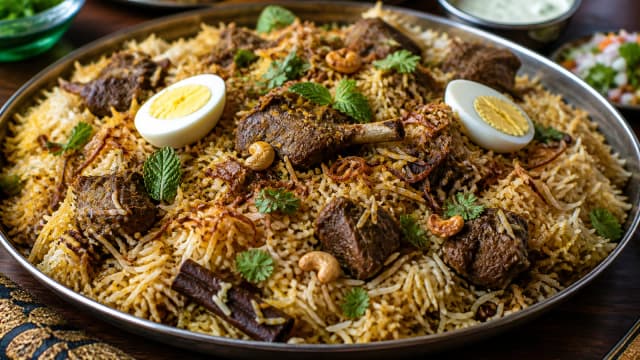
Let's get one thing settled first: Sri Lankan mutton biryani, also called mutton biriyani, is made with goat. The meat gets marinated in yoghurt and Sri Lankan spices, slow-cooked until tender, then layered with par-boiled basmati or seeru samba rice, fried onions, mint and coriander, and finished sealed on low heat. It's deeper and more robust than its chicken sibling, and this goat biryani trades quick cooking for a long, patient tenderising that pulls the meat off the bone and leaves the rice stained gold and heavy with spiced juices. It is the dish that crowns weddings, Ramadan iftars and Eid mornings, served with mint sambol, raita, a fiery acchar and ghee-fried cashews.

Also in our Muslim Sri Lankan collection.
The big-day biryani from Sri Lankan Muslim kitchens: goat slow-cooked until it falls off the bone, marinated in yoghurt and roasted spices, then layered with fragrant rice, sweet fried onions and herbs and finished sealed on dum.
- Total time
- 135 min
- 45 min prep · 90 min cook
- Serves
- 6 people
- Difficulty
- Advanced
- Spice level
- Medium
- Country help
- USA · UK · AU · CA substitutes included
CeylonCooking
ceyloncooking.com/recipes/mutton-biryani
Sri Lankan Mutton Biryani (Mutton Biriyani)
Scan to open on your phone
Nutrition
Estimated values, per serving.
About This Dish
Mutton biryani is the one people save for the biggest days. In Sri Lanka, biryani belongs to the Muslim community, and within that, the goat version carries real weight. It is what comes out for a wedding feast, for the iftar table deep into Ramadan, or as that great sealed pot lifted onto the Eid table while the whole house waits. And mutton here means goat, not lamb. That one fact shapes everything about the dish. Goat has a deeper, almost gamey richness and a tighter, leaner muscle than chicken, so while chicken biryani gets built in an afternoon, mutton biriyani is built around the slow surrender of tough meat into tenderness.
That long cook is the whole point and the whole reward. Goat doesn't give up easily, and a good mutton biryani respects that. The meat is marinated in yoghurt and the island's roasted spices, then braised low and slow, or pressure-cooked, until the connective tissue melts and the pieces slide off the bone. All that time on the heat draws a thick, dark, intensely savoury gravy out of the bones and marrow, far richer than anything a quick-cooking bird can give. By the time the meat is ready, the kitchen smells of cinnamon, clove and slow-cooked goat, and that gravy is what the rice will later drink up under the sealed lid.
What makes it Sri Lankan, not a copy of its famous Indian cousin, is the island's own spice signature. Mutton biryani travelled here with Muslim traders and settled into local kitchens, where it was quietly reshaped: a spoonful of roasted Sri Lankan curry powder alongside the whole cinnamon, cardamom, cloves and fennel, a generous ghee base, and sweet fried onions used not as a garnish but as a backbone, stirred through the meat and layered between the rice. The result is warmer, rounder and a touch sweeter than many Indian mutton biryanis, with the deep goat flavour anchoring every forkful. It's a cousin, not a copy, and the honest way to make it is to lean into those local notes.
The finish is dum, the gentle steam-cook that gives biryani its name. The tender goat and its thick gravy go to the bottom of a heavy pot, the par-boiled rice piles on top with fried onions, mint and coriander, the lid is sealed tight with a rope of dough, and the whole thing rests over the lowest heat while the rice finishes and soaks up the spiced juices. Nothing is stirred. When you finally break the seal, the steam carries mint, fried onion and slow-cooked goat across the room. It's honest, generous cooking that asks for time rather than skill, and that's exactly why it marks the days worth waiting for.
Is Mutton Goat or Lamb in Sri Lanka, and Which Cut Do You Use?
In Sri Lanka, and across much of South Asia, mutton means goat almost always. Not the older sheep that the word points to in Britain. So when a Sri Lankan cook tells you they are making mutton biryani, they mean goat biryani, and that is what gives the dish its deep, slightly gamey flavour. Goat is leaner and more robust than lamb, with less fat and a firmer bite, which is exactly why it can take the long cook and heavy spicing without turning bland. Lamb will work if that is all you can find, but it is milder and cooks faster, so it is a substitute rather than the real thing.
The cut matters as much as the animal. The best mutton biryani starts with bone-in pieces from the shoulder, leg or a mix of stewing cuts, because that is where the flavour and the body of the gravy come from. The bones and connective tissue do the work. Boneless meat cooks faster but gives a thinner, less rounded result. Look for pieces with a little fat and plenty of bone, cut to similar sizes so they tenderise at the same rate. And do not trim them lean. The marrow and gelatine that melt out during the slow cook are what separate a great goat biryani from a dry one.
What It Should Taste Like
Deeply savoury, fall-off-the-bone goat in long, separate grains of rice scented with cinnamon, cardamom, clove and fennel, sweetened by fried onions and lifted by mint and coriander. The whole thing is richer and more robust than chicken biryani, golden from saffron or turmeric, with a thick spiced gravy soaked up by the rice and the rounded depth of ghee holding it all together.
Ingredients
This recipe makes 6 servings. Change the number and every amount below updates with it. Substitutes for hard-to-find items are in the sidebar.
The US button converts grams, millilitres and centimetres to ounces, cups and inches. Spoon measures stay exactly as they are.
Open this in the recipe converter
Mutton and Marinade
- Mutton (goat)bone-in pieces from the shoulder or leg1.2 kg
- Thick yoghurt1 cup
- Ginger garlic paste4 tbsp
- Green chilliesslit or ground3
- Chilli powderto taste1.5 tsp
- Ground turmeric½ tsp
- Roasted Sri Lankan curry powder1.5 tbsp
- Ground fennel1 tsp
- Ground cumin1 tsp
- Mint leaveschopped½ cup
- Coriander leaveschopped½ cup
- Lime juice2 tbsp
- Saltto taste
Rice
- Basmati or seeru samba ricerinsed and soaked for 20 minutes3 cups
- Cinnamon1 stick
- Cardamom podsbruised6
- Cloves6
- Bay leaves2
- Pandan (rampe)1 piece
- Saltfor the boiling water1 tbsp
To Layer and Finish
- Ghee4 tbsp
- Oilfor frying onions4 tbsp
- Onionsthinly sliced, fried golden4 large
- Saffron or turmericsoaked in 3 tbsp warm milk1 pinch
- Cashewsfried in ghee, to garnish¼ cup
- Boiled eggshalved, optional3
Method
Follow these 8 steps. Each one explains not just what to do, but why it matters.
Ready to Start Cooking?
The screen shows one step at a time, with just the ingredients that step needs at your serving count, a timer you can tap, and your phone kept awake.
- 01
Choose and Marinate the Mutton
Mix the bone-in goat pieces with the yoghurt, ginger garlic paste, green chilli, chilli powder, turmeric, roasted curry powder, fennel, cumin, half the mint and coriander, the lime juice and salt until everything is well coated. Cover and rest it for at least 2 hours, or overnight in the fridge.
Goat is leaner and tougher than chicken, so the marinade has to work harder here. Time is your ally. The acidity of the yoghurt and the lime gently breaks down the firm muscle so the meat turns soft instead of chewy, and the spices get into the dense flesh instead of just sitting on the outside. A couple of hours is the minimum, but overnight really is better for goat. Goat needs longer than chicken for the marinade to penetrate. You're using more ginger garlic paste than you would for chicken on purpose: it tenderises as well as flavours. When it is ready, the meat should look pale, spice-flecked and slightly thickened by the yoghurt.

Tip: Before you marinate, pierce the thicker pieces a few times with a knife so the yoghurt and acid can reach the centre of the dense goat meat.
- 02
Fry the Onions
Fry the thinly sliced onions slowly in the oil until they turn deep golden brown and crisp at the edges. Drain them on paper, but do not throw away the spiced oil. You will need it to cook the mutton.
Look, fried onions are the foundation of a biryani, not a garnish, so this step earns its time. Keep the heat moderate and stir often: you want that deep, even, almost mahogany gold and a sweet jammy edge, not a quick scorch. Onions that catch and burn turn bitter and will haunt the whole pot. Properly fried ones collapse into sweetness and melt through the rice. With the richer goat gravy to balance, you want a generous amount, so use four onions and set aside a good handful to scatter on top at the end.

Tip: Pat the sliced onions dry before frying. Dry onions crisp and brown. Wet ones steam and stay pale.
- 03
Brown the Mutton
In a heavy pot, warm the ghee with the reserved spiced oil and brown the marinated goat in batches until it's well coloured on all sides. Then stir half the fried onions back in with the meat and its marinade.
Browning the goat properly builds the deep, caramelised base that the rice will later steam into, and it matters even more with mutton than with chicken because that seared crust is where a lot of the savoury depth lives. Work in batches and let each piece take real colour before you turn it. Crowd the pot and the meat sheds water and stews grey instead of browning. Goat does not brown as quickly as chicken, so be patient and let it sizzle. The fried onions stirred in now begin to melt their sweetness into what will become the gravy.

Tip: Don't deglaze away the brown bits stuck to the pot. They're pure flavour and they'll lift into the gravy as the meat cooks down.
- 04
Slow-Cook the Mutton Until Tender
Add a cup of hot water, cover, and simmer the goat gently for 60-75 minutes, stirring now and then, until the meat is fork-tender and almost falling off the bone and the gravy is thick and dark. Top up with a little hot water only if it threatens to dry out.
This step defines mutton biryani, and it's the reason the dish takes far longer than the chicken version. Goat is full of tough connective tissue that only melts into softness with long, gentle, moist heat, so don't rush it with high flame. Over an hour or so the collagen breaks down into gelatine, the meat slides off the bone, and the gravy turns thick, glossy and intensely savoury as the marrow gives itself up. You want the gravy reduced and clinging, not soupy, because too much liquid will leave the rice wet under the dum. Taste a piece: it should yield with no resistance at all.

Tip: A pressure cooker cuts this to about 20-25 minutes under pressure, which is how many busy Sri Lankan home cooks do it. Just reduce the gravy down afterwards so it's thick before you layer.
- 05
Par-Boil the Rice
Bring a large pot of well-salted water to a rolling boil with the cinnamon, cardamom, cloves, bay leaves and pandan. Add the drained rice and boil for 5-7 minutes until it's about 70 percent cooked, then drain.
The rice is deliberately undercooked here because it finishes steaming on top of the meat. That's the single trick that keeps biryani fluffy rather than mushy. Boiling it in heavily seasoned, spice-perfumed water seasons every grain from the inside before it ever meets the goat. You're looking for a grain that bends and is soft at the edges but still has a firm, slightly chalky core when you bite it. Drain it the moment it reaches that stage, because a minute too long and it'll turn to porridge under the lid.

Tip: Taste a grain at five minutes. The centre should still have that faintest bite, like pasta a minute before al dente.
- 06
Layer the Pot
Spread the tender mutton and its thick gravy across the base of the pot. Pile the drained rice on top, then scatter over the remaining fried onions, the rest of the mint and coriander, and drizzle the saffron or turmeric milk across the surface. Don't stir.
Layering is the whole point, so take your time and do not stir. The goat and its dark reduced gravy sit at the bottom, perfuming and colouring the rice above, while the rice stays loose and separate on top. The saffron or turmeric milk streaks the rice gold in patches, some pale grains, some golden. That marbled look is right. The herbs and fried onions tucked between the layers release their fragrance into the steam as it rises.

Tip: Spoon the saffron milk over in thin lines rather than stirring it through. You want marbled gold and white rice, not a solid yellow.
- 07
Seal and Finish on Dum
Cover with a tight lid. If the lid doesn't fit snugly, press a strip of dough or foil around the rim to seal it. Cook over the lowest possible heat for 20-25 minutes, then turn off the heat and let it rest, still sealed, for 10 minutes.
Dum is the slow steam finish, and it is what gives biryani its name and its soul. The whole point is to trap every bit of steam inside. Sealing the lid, classically with a rope of dough pressed around the rim, stops the fragrant steam escaping, so it circulates back through the rice. That cooks the grains the last of the way and carries the deep spiced flavour from the goat gravy up into them. Keep the heat as low as it will go, ideally over a diffuser, so the bottom does not catch. Letting it rest at the end lets the moisture settle, so the rice firms up and fluffs cleanly.

Tip: If you get a sharp, toasted smell, the base is catching. Pull the pot off the heat, keep it sealed and let the trapped steam finish the job.
- 08
Fluff, Garnish and Serve
Open the pot and gently fold the rice and mutton together, lifting from the bottom rather than stirring. Scatter over the fried cashews, reserved fried onions and halved boiled eggs, then serve hot.
That first lift of the lid is the reward, a cloud of mint, fried onion and slow-cooked goat. Fold gently with a flat spoon, bring the spiced rice and dark gravy up from the bottom through the pale grains on top, so every serving gets both rice and tender meat. Lifting rather than stirring keeps the grains whole and separate. Crown it with crunchy ghee-fried cashews, a final handful of sweet fried onions and a boiled egg or two, then carry it straight to the table while the steam is still rising.

Tip: Serve from the pot at the table if you can. Biryani is a sharing dish, and the spectacle of opening the sealed pot is half the pleasure.
Common Mistakes to Avoid
- Not cooking the goat long enough, so it ends up tough and chewy. Mutton needs 60-75 minutes of gentle simmering, or a spell in the pressure cooker, before it is fork-tender.
- Don't mistake the long cook for high heat. Goat tenderises with low, moist, patient heat. A hard boil toughens it.
- Layering with a thin, watery gravy is the quickest way to soggy rice. Reduce the gravy until it's thick and clinging first.
- If you cook the rice all the way before layering, it'll turn to mush under the lid. Par-boil it to about 70 percent instead.
- Rush the fried onions, or let them burn, and the whole pot tastes bitter instead of sweet.
- If the pot isn't sealed, the steam escapes and the rice stays undercooked and dry.
- Stir the finished biryani hard and you'll break the grains and turn it gluey.
- Skimp on the marinating time and the goat turns out bland and less tender. Overnight is best.
Serving Ideas
- A cool cucumber raita to soothe the spice, and a sharp mint sambol on the side.
- Alongside a fiery malu miris curry or katta sambol for anyone who wants more heat.
- A sweet-sour acchar pickle and a generous scatter of ghee-fried cashews.
- Top it with halved boiled eggs for a generous, celebratory plate.
Building a whole plate around it? Start from our beginner rice and curry menu, which sets out what to cook alongside it and in what order.
Storage and Make-Ahead
Keeps 2 to 3 days refrigerated in a sealed container, and reheats well, covered, with a splash of water to loosen the rice. The goat actually deepens in flavour overnight. It also freezes for up to a month. Add fresh ghee-fried cashews, onions and herbs when you serve it, because the garnishes soften in storage.
Two Ways to Cook It
Use a pressure cooker to tenderise the goat in about 20-25 minutes instead of a long simmer, use good basmati, and use shop-bought fried onions to save time. Cook the assembled biryani in a heavy covered pot on the lowest heat instead of sealing with dough, and use a little garam masala with extra fennel if you can't find roasted Sri Lankan curry powder.
Marinate bone-in goat overnight in yoghurt with roasted Sri Lankan curry powder, fennel and cumin. Fry your own onions slowly until they're deep golden, then braise the mutton low and slow for over an hour until it falls off the bone and the gravy is dark and thick. Par-boil seeru samba or basmati in heavily spiced water, layer with saffron milk, mint and coriander, seal the heavy pot with a rope of dough and finish on dum over a heat diffuser. Garnish with ghee-fried cashews and boiled egg.
Lighter and Healthier Version
Mutton biryani is a rich celebration dish, but goat is naturally leaner than lamb or beef, and a few small changes keep it lighter without losing its fragrance and that deep, slow-cooked character.
Lean on Goat's Natural Leanness
Goat carries far less fat than lamb or beef, so choosing it already keeps the dish leaner. Trim any large visible fat pads before marinating, but leave the bone in for flavour.
Go Easy on the Ghee and Oil
Use a couple of tablespoons of ghee rather than four, and fry the onions in a non-stick pan with less oil or oven-crisp them. Most of the perfume comes from the whole spices and herbs, not the fat.
Skim the Gravy
After the long slow cook, let the gravy settle and skim off any fat that rises to the top before layering. The flavour stays, the richness lightens.
Lean on Yoghurt, Not Cream
Keep the marinade tender and tangy with thick low-fat yoghurt instead of cream or extra ghee.
Try a Wholegrain Rice
Brown basmati or Sri Lankan red rice adds fibre and a nuttier flavour. Par-boil it for longer, since wholegrain rice needs more time before the dum.
Balance the Plate
Keep the rice to a modest mound, pile on the cucumber raita and a fresh salad, and let the vegetables and herbs carry the plate so the meal stays balanced.
Frequently Asked Questions
In Sri Lanka, mutton almost always means goat, not lamb, so a Sri Lankan mutton biryani is a goat biryani. That's the South Asian use of the word, where the older British meaning of mutton as mature sheep doesn't apply. Goat is leaner, firmer and more deeply flavoured than lamb, which is exactly why it stands up to the long cook and heavy spicing. You can make the dish with lamb, but it's milder and cooks faster, so it's a substitute, not the traditional choice.
Cooked It? Tell Us How It Went
Your notes on this sri lankan mutton biryani help the next person get it right: what you swapped, what you would do differently, where the recipe should have warned you. Tap a star if you are in a hurry, or write a few lines if you have a minute.
You Might Also Like


Sri Lankan Home Cooking Starter Pack
40 authentic Ceylon recipes made simple for foreign kitchens: spice guide, pantry checklist, substitute guide, 7-day meal plan and printable shopping lists.