Idicha Sambol
Idi Sambol (Idi Sambal)
Also known as Jaffna Idi Sambol, Pounded Sprat Sambol
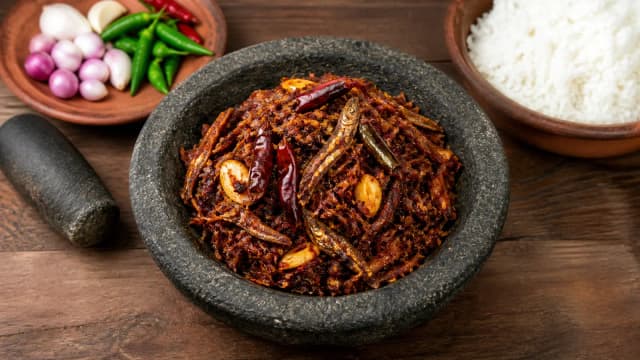
Idi sambol is the pounded sambol of Jaffna, and it is the one cooks talk about the way they do here: good enough to get through a hundred plates of plain white rice. Everything goes into hot oil first, and everything goes in separately. Red onions until they turn golden, then garlic, then dried red chillies, then nai miris or kochchi, and last a handful of dried sprats fried just to the point of crisp. All of it then goes into a stone mortar and gets pounded until the pieces break down and the flavours run into one another. Sugar, chilli flakes, salt and lime juice go in at the end and get pounded through as well. It comes out coarse, dark and properly fiery, and in Jaffna homes it gets made almost every day.

Also in our Jaffna collection.
The Jaffna sambol people say they could eat a hundred plates of plain rice with: red onion, garlic, dried chilli and sprats fried separately, then pounded together with sugar, salt and lime.
- Total time
- 30 min
- 15 min prep · 15 min cook
- Serves
- 6 people
- Difficulty
- Beginner
- Spice level
- Authentic Hot
- Country help
- USA · UK · AU · CA substitutes included
CeylonCooking
ceyloncooking.com/recipes/idi-sambol
Idi Sambol (Idicha Sambol)
Scan to open on your phone
Nutrition
Estimated values, per serving.
About This Dish
Idi, or idicha, means crushed or pounded in Tamil, so the name tells you the method before it tells you anything about the ingredients. This is a sambol you bash in a vangediya, the heavy stone mortar, rather than one you stir together in a bowl. It is a fixture rather than an occasion dish. Jaffna kitchens turn it out almost daily, and part of the reason is that it is hard to get wrong once you know the order things go in.
That order is the whole technique. Every component is fried on its own and lifted out before the next one goes in, because none of them take the same time. Red onions need the longest, and you want them properly golden, not pale. Garlic follows and browns much faster. The dried red chillies are a matter of seconds, just long enough to darken and turn smoky. The nai miris go in after those. The sprats come last of all, fried only until they crisp. Throw the lot in together and the garlic and the sprats are burnt before the onions have taken any colour at all.
The chilli is where cooks differ. Nai miris, the cobra chilli, is fierce and fragrant and it is what a lot of people use. Plenty of Jaffna homes reach for kochchi instead, the small bird's eye chilli, which is hotter and sharper. Either is right. The dried red chillies underneath carry the smoky, toasted note, and the fresh chilli sitting on top of them is what sets the heat, so the choice between the two is really a choice about how hot you want the finished sambol.
The sprats are what stop it being just a chilli paste. Fried crisp and pounded in, haal messo bring salt and a concentrated savoury note that nothing else in the mortar can give, and they carry a little of their crunch through into the finished sambol. Eat it with plain white rice, which is the usual way, or with a hot pol roti and a plain tea, which is the way a lot of people would rather have it.
Fry First, Pound Second
Almost every other Sri Lankan sambol starts with raw ingredients. Idi sambol does not. The onion, garlic, dried chilli, nai miris and sprats all go through hot oil before anything reaches the mortar, and that is what separates it from a lunu miris or a pol sambol. Frying turns the raw bite of the onion sweet, takes the harshness out of the garlic, brings a toasted smokiness up out of the dried chillies and crisps the sprats so they break down instead of staying chewy. What you are pounding, by the time you start pounding, is already cooked.
The second half of the technique is the mortar. Pounding bruises and tears rather than slicing, so the fried pieces give up their oils and bind into one coarse, dark mixture that a blade will never produce. A food processor pulsed carefully will get you close, but it cuts rather than crushes, and it will go to a smooth paste faster than you expect. Idi sambol should stay textured, with the sprats and chilli still visible in it, never worked down into something smooth.
What It Should Taste Like
Dark, coarse and seriously hot, with sweetness from the fried red onion, a deep roundness from the fried garlic, a smoky note from the dried chillies and a salty, savoury crunch from the sprats. The pinch of sugar sits underneath rather than reading as sweet, and the lime lifts the whole thing at the end. It should taste concentrated. A spoonful is meant to season a plate of rice, not fill it.
Ingredients
This recipe makes 6 servings. Change the number and every amount below updates with it. Substitutes for hard-to-find items are in the sidebar.
The US button converts grams, millilitres and centimetres to ounces, cups and inches. Spoon measures stay exactly as they are.
Open this in the recipe converter
For Frying
- Coconut oil or vegetable oilenough to cover what goes in a small panto deep fry
Fried Separately, One After Another
- Small red onions or shallotspeeled, halved if large15-20
- Garlic clovespeeled10-12
- Dried red chilliesstems pulled off; adjust to taste12-15
- Nai miris or kochchicobra chilli or bird's eye chilli, left whole4-6
- Dried sprats (haal messo)about half a cup, rinsed and dried well50 g
To Finish in the Mortar
- Sugar1 tsp
- Chilli flakesto taste1-2 tsp
- Saltthe sprats are salty alreadyto taste
- Limejuiced, as much as you likehalf to 1
Method
Follow these 6 steps. Each one explains not just what to do, but why it matters.
Ready to Start Cooking?
The screen shows one step at a time, with just the ingredients that step needs at your serving count, a timer you can tap, and your phone kept awake.
- 01
Fry the Red Onions, Then the Garlic
Heat enough oil in a small pan to cover the ingredients. Fry the peeled red onions until they are golden, lift them out with a slotted spoon and drain them. Fry the garlic in the same oil until it is golden, then lift that out too and set both aside.
Two things are happening in the oil here. The onions lose their raw sharpness and turn sweet and soft-centred, which is the sweetness you taste under the heat in the finished sambol. The garlic loses its aggressive edge and turns round and nutty. They come out at different times because they cook at different speeds. Onions take several minutes and want to go properly golden, while garlic can get there in under a minute. This is also why they go in one after the other rather than together.

Tip: Garlic turns bitter the moment it goes past golden, and there is no rescuing it. Fry it on its own, keep your eyes on it, and pull it out a shade earlier than you think you need to.
- 02
Fry the Dried Chillies, Then the Nai Miris
Drop the dried red chillies into the same oil for a few seconds, until they darken and smell smoky, then lift them out. Fry the nai miris or kochchi next, until the skins blister, and set those aside as well.
Frying the dried chillies is what gives idi sambol its smoky backbone, and it is the fastest step in the recipe. A dried chilli in hot oil swells slightly, deepens a shade and gives off a warm toasted smell, and that all happens in seconds rather than minutes. Take it a moment further and the chilli blackens and turns bitter, and the bitterness will run all the way through the finished sambol. The nai miris go in after, and being fresh they blister and soften rather than darken.

Tip: Have the slotted spoon in your hand before the chillies go in. Work by smell, not by the clock, and lift them the moment they turn fragrant.
- 03
Fry the Sprats Just to Crisp
Last into the oil go the dried sprats. Fry them only until they turn crisp, and lift them out before they take on any real colour.
Sprats are small and already dry, so they crisp quickly and then keep going. You want them brittle enough to break under the pestle but still pale, because a sprat fried dark tastes burnt and that is the one flavour that will dominate everything else in the mortar. Rinse them first to wash off loose salt, then dry them thoroughly on a cloth. Wet sprats make the oil spit and steam themselves soft instead of crisping.

Tip: Fry them in two batches rather than crowding the pan. A crowded pan drops the oil temperature and the sprats go soft and greasy instead of crisp.
- 04
Pound Everything Together
Tip the fried dried chillies, garlic, red onions, nai miris and sprats into a stone mortar and pound. Keep going until the pieces break down and the flavours run together into one coarse, dark mixture.
This is the step the dish is named after. Pounding crushes and tears the fried pieces so the oils they took up in the pan get worked through the whole mixture, and the sprats and chillies break into flecks rather than slices. Give it a few minutes. It looks like separate fried things for a while and then, quite suddenly, it comes together and starts smelling like one dish rather than five. Stop while it is still coarse and you can see what is in it.

Tip: Start with the chillies and the sprats, which need the most work, and add the softer fried onion and garlic on top once those have broken down.
- 05
Season It and Pound Again
Add the sugar, chilli flakes, salt and as much lime juice as you like, then pound for another minute or two so everything mixes through evenly.
The seasoning goes in at the end so it stays bright. The sugar is not there to sweeten the sambol, it is there to round off the edges of the chilli and the salt, and at a teaspoon across the whole batch you should not be able to taste it as sugar. The chilli flakes lift the heat and add colour. The lime does the same job it does in any sambol, cutting through the fried oil and pulling the salt and heat into focus. Pound rather than stir, so the liquid works right through the mixture.

Tip: Add the lime a little at a time and taste as you go. Salt last, once the lime is in, because the sprats have already brought a good deal of their own.
- 06
Taste, Adjust and Serve
Taste a proper spoonful, adjust the salt, heat and lime, and serve it at room temperature. Plain white rice is the usual partner, but a hot pol roti and a plain tea is just as good.
A fingertip taste will mislead you here, because the salt hits first and the sweetness and smoke arrive behind it. Take a spoonful with a little rice if you can. What you are after is heat first, then the sweet fried onion and garlic underneath it, then the salty crunch of the sprats, with the lime running through the lot. If it tastes flat, it usually wants lime rather than salt.

Tip: Make it a little ahead if you can. An hour in the bowl lets the fried oil settle through the sambol and the flavours read as one thing rather than several.
Common Mistakes to Avoid
- Frying everything in one go. The garlic and sprats burn long before the onions have coloured, which is the whole reason each one is fried on its own.
- Taking the garlic past golden. It turns bitter, and that bitterness carries through the entire sambol.
- Frying the dried chillies until they blacken. A few seconds too long and the mortar tastes acrid.
- Letting the sprats brown. Crisp and pale is what you want. Dark sprats taste burnt and overpower everything else.
- Blending it smooth. Idi sambol is meant to stay coarse and flecked, with the sprats and chilli still visible.
- Salting before tasting. The sprats are cured and bring plenty of salt of their own.
- Leaving out the sugar because it sounds wrong in a sambol. That teaspoon is what rounds off the chilli and the salt.
- Skipping the frying and using raw onion and garlic. That makes a different sambol, closer to a lunu miris.
Serving Ideas
- With plain white rice, which is how it is most often eaten in Jaffna.
- With a hot pol roti and a plain tea.
- Alongside string hoppers, hoppers or pittu at breakfast.
- On a rice and curry plate, as the hot corner of it.
- Spread thinly on bread or toast, in much smaller amounts than you would use a chutney.
Building a whole plate around it? Start from our beginner rice and curry menu, which sets out what to cook alongside it and in what order.
Storage and Make-Ahead
Because everything in it is fried and there is no coconut, idi sambol keeps far better than most sambols. Store it in a clean sealed jar in the fridge and it will hold for 4 to 5 days, and many cooks think it is better on the second day once the fried oil has settled through it. The lime dulls first, so refresh it with a fresh squeeze and bring it back to room temperature before serving. It can be frozen in small portions for up to a month, though the sprats lose some of their crunch.
Two Ways to Cook It
You do not need a deep pan of oil or a stone mortar. Shallow fry each thing in a few tablespoons of oil in a small frying pan, in the same order, lifting each one out before the next goes in. Then pulse everything in a small food processor in short bursts, scraping down between them, and stop while it is still coarse. Add the sugar, chilli flakes, salt and lime and pulse once or twice more. Use 6 to 8 dried chillies rather than 12 to 15 the first time.
Deep fry each component in turn in coconut oil, red onions to a deep gold, then garlic, then dried chillies, then kochchi, then the sprats, draining each one as it comes out. Pound the lot on a vangediya, the stone mortar, until it comes together coarse and dark, then work in the sugar, chilli flakes, salt and lime and pound again. The stone and the separate frying are the two things that make it taste like Jaffna rather than like a blended chilli paste.
Lighter and Healthier Version
The oil is the only heavy part of this, and most of it stays in the pan rather than in the sambol. Still, if you want to cut it back, there is room to do that without losing the character of the dish. The frying is what matters, not the depth of the oil.
Shallow Fry Instead
A few tablespoons of oil in a small pan will fry all five components in turn perfectly well. Turn them more often and give them a little longer.
Drain Properly
Lift each batch onto kitchen paper as it comes out and let it drain before it goes into the mortar. That alone takes out a surprising amount of the oil.
Dry-Roast the Chillies
The dried red chillies can be dry-roasted in a hot pan rather than fried, and they still come out smoky. Fry only the onion, garlic and sprats.
Watch the Salt
The sprats are cured and salty. Taste before you add any salt at all, and lean on the lime and the chilli flakes instead.
Watch How to Make It
Read the steps already? Watch the whole process from start to finish to see the texture, colour and timing at each stage.
Sri Lankan Idi Sambal, Start to Finish
Narrated in Sinhala (සිංහල)
Every ingredient fried on its own before anything is pounded: red onion, garlic, dried chillies, nai miris and sprats, one after another. Everything then goes into a stone mortar with sugar, chilli flakes, salt and lime. Narrated in Sinhala.
සිංහලෙන් කෙටියෙන්
ඉඳි සම්බෝල කියන්නේ යාපනයේ ගෙවල්වල හැමදාම වගේ හදන, වංගෙඩියේ තලාගන්නා සම්බෝලයක්. සුදු හාල් බත් එක්ක කන්න පුළුවන් තරමටම රසයි.
මෙතන තියෙන වැදගත්ම දේ තමයි හැම දෙයක්ම වෙන වෙනම තෙලේ බැදගැනීම. රතු ලූණු, සුදු ලූණු, වේලපු මිරිස්, නයි මිරිස් සහ හාල් මැස්සෝ එකට දැම්මොත් සුදු ලූණුයි හාල් මැස්සොයි පිච්චෙනවා, ලූණු තාම බැදිලාවත් නෑ. ඒ නිසා එකින් එක බැදලා අරගෙන පැත්තකින් තියාගන්න.
බැදීම ඉවර වුණාම ඔක්කොම වංගෙඩියට දාලා හොඳට තලාගන්න. ඊට පස්සේ සීනි, කෑලි මිරිස්, ලුණු සහ දෙහි යුෂ දාලා ආයෙත් ටිකක් තලාගන්න. සුදු හාල් බත් එක්ක හෝ රස්නේ තියෙන පොල් රොටියක් එක්ක කන්න පුළුවන්.
- රතු ලූණු රන් පාට වෙනකන් තෙලේ බැදගන්න
- සුදු ලූණු වෙනම බැදලා පැත්තකින් තියාගන්න
- වේලපු මිරිස් සහ නයි මිරිස් (නැත්නම් කොච්චි) තත්පර කිහිපයක් බැදගන්න
- හාල් මැස්සෝ කර වෙන්නේ නැති ගානට බැදගන්න
- ඔක්කොම වංගෙඩියට දාලා හොඳට තලාගන්න
- සීනි, කෑලි මිරිස්, ලුණු සහ දෙහි දාලා ආයෙත් තලාගන්න
Filmed by My Drooling Recipes. We did not make this video, we are linking to theirs.
Watch on FacebookFrequently Asked Questions
Idi sambol is a Jaffna pounded sambol made from red onion, garlic, dried red chillies, nai miris or kochchi and dried sprats. Each one is fried separately in hot oil, then all of it is pounded together in a stone mortar and finished with sugar, chilli flakes, salt and lime juice. It comes out dark, coarse and very hot, and it is eaten in small amounts with plain rice, pol roti, string hoppers or pittu. In Jaffna homes it is an everyday thing rather than a special one.
Cooked It? Tell Us How It Went
Your notes on this idi sambol help the next person get it right: what you swapped, what you would do differently, where the recipe should have warned you. Tap a star if you are in a hurry, or write a few lines if you have a minute.
You Might Also Like


Sri Lankan Home Cooking Starter Pack
40 authentic Ceylon recipes made simple for foreign kitchens: spice guide, pantry checklist, substitute guide, 7-day meal plan and printable shopping lists.