Bittara Rolls
Sri Lankan Egg Rolls (Chinese Rolls)
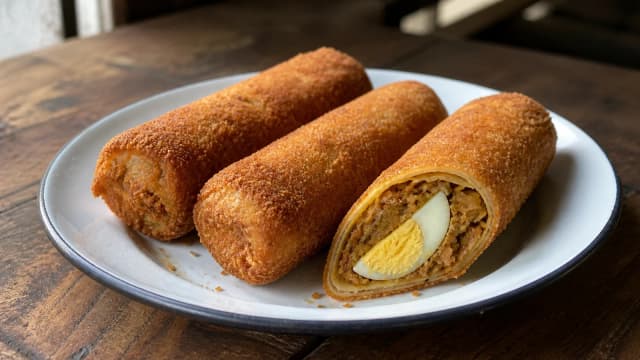
Sri Lankan egg rolls are known locally as bittara rolls, and you'll often see them listed as Chinese rolls on bakery menus. They're thin savoury pancakes wrapped around a spiced fish or chicken filling, with a slice of boiled egg tucked inside. Then they're crumbed and deep-fried until crisp and golden. This is the classic Sri Lankan short eat you find in every bakery, and it has nothing to do with the cabbage-filled American or Chinese egg roll. It's a crepe roll: soft, spiced filling and a hidden egg sealed inside a shatteringly crisp breadcrumb shell.

The bakery short eat that started it all: a crisp, crumbed crepe rolled around spiced fish and a slice of boiled egg, deep-fried golden.
- Total time
- 70 min
- 45 min prep · 25 min cook
- Serves
- 8 people
- Difficulty
- Advanced
- Spice level
- Medium
- Country help
- USA · UK · AU · CA substitutes included
CeylonCooking
ceyloncooking.com/recipes/egg-rolls
Sri Lankan Egg Rolls (Bittara Rolls)
Scan to open on your phone
Nutrition
Estimated values, per serving.
About This Dish
Walk into any Sri Lankan bakery in the late afternoon and you'll see the glass cabinet lined with short eats, those small savoury snacks that keep the country fed between meals. Among the patties, cutlets and rolls, the egg roll is the one many people reach for first. It's a plump, golden log, crisp on the outside, and when you bite in, you get a spiced fish filling wrapped around a slice of boiled egg. Sri Lankans call it bittara roll. Bittara means egg in Sinhala. And you'll just as often see it on the menu as Chinese roll, a name that's stuck for generations even though this snack is thoroughly Sri Lankan.
The 'Chinese' in the name is a nod to the thin pancake or crepe at the heart of the roll. That technique arrived through Chinese influence and was happily absorbed into the local short-eats repertoire, right alongside cutlets and patties. But make no mistake, this is not the American egg roll stuffed with cabbage, and it's not a spring roll. It's its own thing entirely. A loose batter of flour, egg and water gets cooked into delicate crepes. Each one is rolled around a savoury filling, sealed, dipped in egg, rolled in breadcrumbs and deep-fried. What you end up with is a snack with three textures in one bite: the crackle of the crumb, the softness of the crepe and the comfort of the spiced filling.
These rolls do it all: tea-time food, party food, lunchbox food. You'll see them at birthday tables and office gatherings, and they're sold by the dozen at the bakery. At home, when there are people to feed, they get made in big trays. The filling is usually spiced tinned fish or chicken bound with mashed potato. But it's the boiled egg tucked in the middle that earns the roll its name, and that's also what makes biting into one feel like a small reward. They do take a little patience to assemble, but a batch goes a long way, and the smell of them frying is one of those things that pulls everyone into the kitchen.
Sri Lankan Egg Rolls vs Egg Rolls?
A Sri Lankan egg roll is a crumbed, deep-fried crepe roll with a boiled egg inside. It is not the thick, cabbage-filled egg roll you might know from American Chinese takeaways, and it's not a spring roll either. The confusion is all in that shared word 'egg'. Here, the egg refers to the slice of boiled egg sealed inside the roll, and also to the egg in the crepe batter and the dip that helps the breadcrumbs stick. The wrapper is a soft, thin pancake, not a wheat or rice-paper skin. And the filling is a spiced mash of fish or chicken, not shredded raw vegetables. This is a short eat, a savoury bakery snack, sold alongside cutlets, patties and fish buns.
The local names tell you the story. Bittara roll means 'egg roll' in Sinhala, and 'Chinese roll' is the older menu name. It points to the crepe rolling technique, not some Chinese filling. So if a recipe promises shredded cabbage, bean sprouts and a crunchy wheat wrapper, that is a different dish from another cuisine. The Sri Lankan version is crepe, spiced filling, boiled egg, breadcrumbs and hot oil, full stop. Knowing the difference saves you a lot of disappointment when you search for the real thing.
What It Should Taste Like
A shatteringly crisp, deep-golden breadcrumb shell gives way to a soft crepe, a warmly spiced fish or chicken filling and a slice of boiled egg in the centre. Savoury and mildly hot, with curry leaf and black pepper running through.
Ingredients
This recipe makes 8 servings. Change the number and every amount below updates with it. Substitutes for hard-to-find items are in the sidebar.
The US button converts grams, millilitres and centimetres to ounces, cups and inches. Spoon measures stay exactly as they are.
Open this in the recipe converter
Pancakes (Crepe Batter)
- Plain flour1 cup
- Egg1
- Water or milkenough for a thin, pourable batter1¼ cups
- Salt¼ tsp
- Ground turmericoptional, for colour¼ tsp
- Oilfor greasing the pan
Filling
- Tinned mackerel or tunadrained and flaked; or cooked shredded chicken1 tin (about 180 g)
- Potatoesboiled and mashed2 medium
- Onionfinely chopped1
- Green chilliesfinely chopped2
- Garlicminced2 cloves
- Curry leaveschopped1 sprig
- Sri Lankan curry powder1 tsp
- Chilli powderto taste½ tsp
- Ground black pepper½ tsp
- Lime juice1 tsp
- Boiled eggshalved, then each half sliced; one piece per roll4
- Oilfor frying the filling1 tbsp
- Saltto taste
Coating
- Eggbeaten, for dipping1
- Breadcrumbsfine, dry1½ cups
- Oilfor deep-frying
Method
Follow these 6 steps. Each one explains not just what to do, but why it matters.
Ready to Start Cooking?
The screen shows one step at a time, with just the ingredients that step needs at your serving count, a timer you can tap, and your phone kept awake.
- 01
Make the Spiced Filling
Heat the oil and fry the onion, green chilli, garlic and curry leaves until soft. Then stir in the flaked fish, curry powder, chilli powder and pepper. Fold through the mashed potato, season with salt and lime, and let it cool completely.
The filling has to be cooked, well seasoned and, above all, dry. Any wetness makes a roll burst in the oil later, so cook the mixture until it pulls cleanly away from the pan and looks almost crumbly, not loose. The mashed potato isn't filler; it binds the flaked fish into something that holds its shape when you roll it, and carries the spice evenly. Taste it now while you can still adjust, because once it's sealed inside a crepe, there's no fixing it. Spread it on a plate to cool fast; a warm filling will tear a delicate crepe.

Tip: Make the filling a little punchier than you think it needs. The bland crepe and the breadcrumb shell will mute it once everything is assembled.
- 02
Cook the Thin Crepes
Whisk the flour, egg, salt and turmeric with the water or milk into a smooth, thin batter. Lightly grease a non-stick pan, pour in a small ladle of batter, swirl to a thin round, and cook until set on top and just coming away at the edges. Stack the crepes as you go.
These crepes are the wrapper, so thin and supple beats thick and sturdy every time. The batter should be runnier than pancake batter, more like single cream, so it swirls into a delicate sheet that rolls without cracking. You're cooking them on one side mostly, until the surface looks dry and matte and the edges lift. They don't need colour and they don't need flipping for long. Resting the batter for ten minutes lets the flour hydrate, which makes for softer, less rubbery crepes. Stack them with a clean cloth between if they feel sticky.

Tip: If the first crepe tears or feels thick, the batter is too stiff. Loosen it with a splash more water until it swirls thinly across the pan.
- 03
Fill and Roll
Lay a crepe down, spoon a line of cooled filling across the lower third, and press a slice of boiled egg into it. Fold the bottom edge over, fold in both sides like an envelope, then roll up into a tight, neat log.
This step defines the snack. The boiled egg is the whole reason it is a bittara roll, not just a fish roll. Keep the filling to a firm, compact line. Overstuff it and the roll splits at the seams. Leave it loose and it falls apart in the oil. Fold the sides in before you roll, because that traps the filling at both ends so nothing leaks during frying. Roll it snug, like a small spring roll or a burrito, and set it seam-side down. Its own weight helps keep it closed while you work through the rest.

Tip: Don't overfill. A modest amount of filling that rolls into a firm, sealed log fries far better than a fat, bulging one.
- 04
Crumb the Rolls
Dip each rolled crepe in the beaten egg, let the excess drip off, then turn it in the breadcrumbs until fully and evenly coated. Press the crumbs on gently and re-dip any bare patches.
The egg dip is glue. The breadcrumbs are armour. Together they make the crisp shell that defines a Sri Lankan egg roll. Just as important, they seal the seam so the filling stays put in the hot oil. Coat every part, especially the ends and the seam. A bare spot is exactly where oil gets in and the roll bursts. A second dip and crumb gives an even thicker, crunchier crust if you want it. Let the crumbed rolls sit for a few minutes so the coating sets before they fry.

Tip: Keep one hand for the wet egg and one for the dry crumbs. Mixing them turns your fingers into a clumpy mess and the coating goes patchy.
- 05
Deep-Fry Until Golden
Heat oil to a medium-hot frying temperature, around 170 to 180C/340 to 355F. Fry the rolls in small batches, turning, until deep golden and crisp all over, about 3 to 4 minutes. Drain on paper.
Everything inside is already cooked. Frying is only about crisping the shell and warming the centre. That's why steady, medium-hot oil matters more than blazing heat. Too hot and the crumbs burn before the inside warms. Too cool and the rolls drink oil and turn greasy. Drop in a pinch of breadcrumbs to test. They should sizzle and rise straight away without browning instantly. Fry in small batches so the oil stays hot and the rolls have room to turn and colour evenly into that signature deep gold.

Tip: Listen and look. A steady, lively sizzle and slow, even browning mean the oil is right. Furious bubbling and fast colour mean it is too hot.
- 06
Rest and Serve
Lift the rolls onto kitchen paper and let them rest a couple of minutes before serving. Eat them warm, while the shell is at its crispest.
A short rest on paper lets surface oil drain and the steam inside settle. The first bite is crisp, not greasy, and the filling is not scalding. These rolls are at their best fresh and warm, when the crumb still shatters and the egg in the middle is soft. They lose their crunch as they cool and sit. That's exactly why bakeries fry them in waves through the afternoon. Pile them up, put out something tangy to dip into, and serve straight away.

Tip: If you're making a big batch, keep fried rolls warm and crisp in a low oven on a rack, not stacked on a plate where they steam and soften.
Common Mistakes to Avoid
- A wet or under-cooked filling steams and makes the roll burst in the oil.
- Crepes that are too thick or too dry crack when you try to roll them.
- Overstuffing the rolls makes the seams split and the filling leak while frying.
- If the oil's too hot, the crumbs brown before the centre has a chance to warm through.
Serving Ideas
- Eat them straight from the pan, still hot, with a fresh oniony lunu miris or a chilli sauce for dipping.
- Serve them as a tea-time short eat with fish cutlets and a cup of milk tea.
- Pile them on a platter for a party, a birthday table or an office gathering.
Building a whole plate around it? Start from our sri lankan party menu menu, which sets out what to cook alongside it and in what order.
Storage and Make-Ahead
These are best the day they're fried, while the shell is still properly crisp. Cooked rolls keep 1 to 2 days in the fridge, but re-crisp them in a hot oven or air fryer. A microwave will turn them soggy, so skip it. To make them ahead, freeze the assembled, crumbed, uncooked rolls in a single layer, then fry from frozen for a few extra minutes. That's the best way to plan ahead.
Two Ways to Cook It
Grab shop-bought thin crepes or wrappers, make a simple filling of tinned fish and potato, and shallow-fry the crumbed rolls in a few centimetres of oil, turning them until golden. Fewer rolls, less batter to master.
Cook your own thin flour and egg crepes, fill them with spiced mackerel and mashed potato around a slice of boiled egg, then double-crumb each roll for a thick crust and deep-fry in medium-hot oil until deep golden. That's the bakery way.
Lighter and Healthier Version
Egg rolls are a deep-fried treat by nature, but a few changes give you a noticeably lighter version with the same crisp shell and spiced filling, without a whole pan of oil.
Air-Fry Instead of Deep-Fry
Brush or spray the crumbed rolls lightly with oil and air-fry at around 190C/375F for 10 to 12 minutes, turning once, until crisp and golden. You use a fraction of the oil and still get a seriously good crunch.
Bake on a Rack
No air fryer? Bake the crumbed rolls on a wire rack set over a tray at 200C/400F for about 18 to 20 minutes, turning halfway, so hot air can crisp every side without any shallow oil.
Lighten the Filling
Add more vegetables and herbs and less potato, use a heart-healthy oil sparingly when you fry the filling, and let curry leaf, pepper and lime carry the flavour rather than more fat.
Use Wholegrain Crumbs
Swap white breadcrumbs for wholemeal or panko made from wholegrain bread for a little more fibre, and crumb once instead of twice for a thinner, lighter shell.
Frequently Asked Questions
A Sri Lankan egg roll is a thin savoury crepe wrapped around a spiced fish or chicken filling and a slice of boiled egg, then crumbed and deep-fried until crisp and golden. Locally it's called bittara roll or Chinese roll, and it's a classic bakery short eat: crunchy breadcrumb shell, soft pancake inside, egg in the centre.
Cooked It? Tell Us How It Went
Your notes on this sri lankan egg rolls help the next person get it right: what you swapped, what you would do differently, where the recipe should have warned you. Tap a star if you are in a hurry, or write a few lines if you have a minute.
You Might Also Like


Sri Lankan Home Cooking Starter Pack
40 authentic Ceylon recipes made simple for foreign kitchens: spice guide, pantry checklist, substitute guide, 7-day meal plan and printable shopping lists.