Ambarella Chutney (June Plum Chutney)
Also known as Golden Apple Chutney
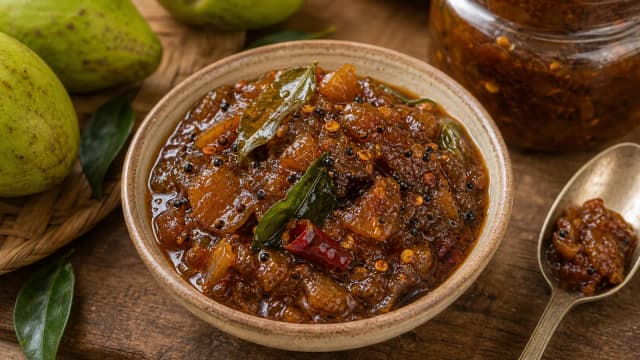
Also called golden apple chutney, though my grandmother just called it 'the sour one'. Ambarella chutney, or June plum chutney, is what a Sri Lankan kitchen makes when the tree drops more fruit than anyone can eat raw. You peel the hard green ambarella, carve the flesh off its spiky seed, and simmer it slowly with sugar, vinegar, chilli and ginger until it sets into a dark, sticky relish that is sour and sweet at once. It keeps for weeks in the fridge and, if anything, tastes better after a few days. A jar of this means even the saddest Tuesday-night rice and dhal has something bright and bracing beside it.

Tart green ambarella cooked down with sugar, vinegar and chilli into a sharp, sweet-hot relish. It is the jar that rescues a plain plate of rice and curry.
- Total time
- 50 min
- 20 min prep · 30 min cook
- Serves
- 12 people
- Difficulty
- Beginner
- Spice level
- Medium
- Country help
- USA · UK · AU · CA substitutes included
CeylonCooking
ceyloncooking.com/recipes/ambarella-chutney
Ambarella Chutney
Scan to open on your phone
Nutrition
Estimated values, per serving.
About This Dish
The ambarella tree behind my aunt's house in Ratnapura drops fruit like it is angry at the ground. August is the worst, or the best, depending on how much peeling you can take. You gather them green and hard, the size of a small egg. Leave them a week and they soften and sweeten, losing that mouth-puckering bite that makes this chutney worth the effort.
So we make chutney. Not because it is fancy, but because it is thrifty. A tree in fruit gives you far more ambarella than one household can get through, so the sour green ones get peeled, chopped and simmered down until they keep. The vinegar and sugar do the preserving. The chilli, ginger and whole spices do the seasoning. The reward is a jar at the back of the fridge that quietly improves week after week.
If you have never met one, imagine a green mango and a Granny Smith apple had a baby, and that baby rolled around in pineapple juice. It is sour first, crunchy, with an almost pine-like sharpness at the back of your nose. The seed inside is a nightmare. Fibrous, spiky, nothing like a smooth mango stone. You cannot cut through it. You have to carve around it like filleting a fish, and if your knife is dull, good luck. I have lost a chunk of thumb more than once.
Sliced raw with salt and chilli powder, sold in little newspaper cones by the roadside, that is how most Sri Lankans first meet ambarella. It is a snack. Chutney is what happens when the tree wins and you have forty of them on the counter, judging you. The texture is the whole point. A mango melts into smooth jam, but ambarella refuses to. Even after half an hour on the heat the pieces keep a tender chew, so you get recognisable fruit suspended in thick syrup rather than a uniform spread.
Green vs Yellow: Pick the Right One
You want firm green ambarella for chutney, not the yellow-ripe ones, and I learned this the lazy way. One year I thought, they are sweeter when yellow, so the chutney will be better, right? Wrong. The fruit collapsed into mush within fifteen minutes of simmering. It tasted fine, a kind of honeyed tropical jam, but it was not chutney. It was baby food with vinegar.
If you want those tender, chewy pieces suspended in syrup, you need the sour, hard, unripe fruit. It fights back against the heat and keeps its shape. As ambarella ripens, it turns yellow-gold, softens and grows fragrant, lovely eaten out of hand but too soft for a preserve. For a classic tangy chutney, firm and green is the one to choose.
What It Should Taste Like
It's sharp first, then sweet. The sourness of green ambarella hits before the sugar catches up, with a warm chilli heat behind it and ginger threading through. The fruit stays in tender pieces, never mush, in a thick amber syrup. If it tastes flat or only sweet, it wants more vinegar or chilli.
Ingredients
This recipe makes 12 servings. Change the number and every amount below updates with it. Substitutes for hard-to-find items are in the sidebar.
The US button converts grams, millilitres and centimetres to ounces, cups and inches. Spoon measures stay exactly as they are.
Open this in the recipe converter
The Fruit
- Ambarella (June plum)Firm and green, about 500 g peeled and chopped.6-8
- Salt1 tsp
The Spice Base
- OilCoconut oil smells right here, but any neutral oil works.2 tbsp
- Mustard seeds1 tsp
- GarlicFinely chopped.4 cloves
- GingerFinely chopped or grated.2 tbsp
- Curry leavesOptional.1 sprig
- Cinnamon1 small stick
- Cloves3
- Chilli powderAdjust for heat.1-2 tsp
- Ground turmeric¼ tsp
The Cook-Down
- SugarAbout ¾ cup, or jaggery, adjust to taste.150 g
- VinegarWhite or cider vinegar.4 tbsp
- WaterIf needed.a splash
Method
I won't pretend these are perfect little instructions. I've made this chutney maybe thirty times, and honestly half of those I was winging it while yelling at someone to get me more salt. Here's roughly how it goes.
Ready to Start Cooking?
The screen shows one step at a time, with just the ingredients that step needs at your serving count, a timer you can tap, and your phone kept awake.
- 01
Peel and Chop the Ambarella (and Don't Fight the Seed)
Peel the tough green skin with a sharp paring knife or a sturdy peeler. Stand each fruit upright, slice the flesh away from the seed in panels, then chop into rough 1 cm chunks. Toss with the salt and set aside.
Get a properly sharp knife, not the one you keep meaning to sharpen and never do. The skin is thin but surprisingly tough, so go slowly. Then the seed: don't try to cut through the middle like a mango. I did that exactly once, the knife skidded off the fibrous core, and I nearly took the tip of my finger off. It's covered in stiff, spiky bristles that make it genuinely unpleasant to handle, so carve the flesh away in panels around it instead. The chunks don't have to be perfect, but keep them vaguely even so they cook at the same rate. Salting now pulls a little moisture out and seasons the fruit from the inside, not just the surface.

Tip: Wear an apron, the juice splatters and it stains. And cut on a board, not in your palm. That's how you end up with a scar. Ask me how I know.
- 02
Toast the Mustard Seeds and Aromatics
In your widest pan, heat the oil over medium. Add the mustard seeds, and when they pop, add the garlic, ginger, curry leaves, cinnamon and cloves. Stir for about a minute until fragrant.
Use your widest pan, because more surface means faster reduction later and you want that. I use coconut oil since it just smells right for this, but any neutral oil is fine. Drop the mustard seeds in and wait; when they start popping they will jump right out of the pan if you're not careful. Then add the garlic, ginger, curry leaves (skip them if you have none, but they add that Sri Lankan kitchen smell), cinnamon and cloves. The garlic should go golden and fragrant, not brown, because burnt garlic tastes bitter and mean and you can't undo it. That sharp, warm smell the moment the ginger and curry leaves hit the oil is the backbone of the whole jar, so don't rush it.

Tip: A wide, heavy pan beats a deep narrow one here. That extra surface helps the chutney reduce evenly later on.
- 03
Bloom the Ground Spices (and Don't Burn Them)
Turn the heat down a notch, then stir in the chilli powder and turmeric. Fry for about 30 seconds, until the oil turns a deep red-gold, taking care not to scorch them.
Stir fast here, because ground spices burn far quicker than whole ones. In about 30 seconds the oil goes a deep red-gold and the raw, dusty edge of the chilli mellows into something warmer. If the pan feels too hot, just pull it off the heat for a moment while you stir. Better that than acrid burnt-chilli chutney, which is bin-worthy, trust me.

Tip: First time making this? Start with the smaller amount of chilli powder. You can always add more heat later, but you can't take it out.
- 04
Add the Fruit and Let It Get to Know the Spices
Tip in the chopped ambarella and stir so every piece is coated in the spiced oil. Cook for 4-5 minutes, until glossy and tinged gold but still firm.
The fruit is still hard and crunchy at this point. Do not expect it to soften. You are just waking it up. The pieces go glossy and take on a golden colour from the turmeric, and that sharp raw smell starts to mellow, still sour but less aggressive. You will notice the fruit holds its shape, which is exactly what you want. If it collapses now, you have used overripe ambarella. I am sorry, but you are making jam, not chutney.

Tip: Even-sized chunks pay off here. Cut them to a similar thickness and they soften at the same rate, so nothing stays raw and crunchy while the rest turns soft.
- 05
Sugar and Vinegar: The Sweet-Sour Heart
Pour in the sugar and vinegar and stir. Bring it to a gentle simmer, adding only a tiny splash of water if the pan looks bone-dry. Taste the syrup and dial in the balance.
The sugar melts into a syrup and the vinegar hits your nose sharp, almost too sharp. Don't worry, that harshness cooks off. If the pan looks bone-dry, and ambarella doesn't always give up much liquid, add a tiny splash of water, but go easy. Too much and you'll be simmering for forty minutes. Taste after a minute or two and dial it in: more sugar for a sweeter, jammier jar, more vinegar for a sharper, fiercer one. I like mine in the middle, sweet first, then the sour kicks you in the jaw and the chilli trails behind. But you do you, I'm not standing in your kitchen.

Tip: Whatever sugar you use, white, brown or jaggery, do not cut it by more than a third. It preserves the chutney as much as it sweetens it. Skimp and the jar will not keep.
- 06
Simmer It Down (and Stir, Stir, Stir)
Lower the heat and simmer gently for 18 to 22 minutes, stirring often, especially near the end. You want it thick and glossy, and a spoon dragged across the pan leaves a trail that holds for a second.
I know stirring is boring. Put on a podcast, but do not walk away. You will watch it change: the syrup tightens and goes glossy, the colour deepens to a rich amber, and the fruit softens to a tender chew without falling apart. If the syrup pools watery around the fruit, it needs more time. If it is so thick the spoon stands up, you have gone too far, and it will stiffen further as it cools into sticky fruit toffee. Delicious on toast, but not what we are after here.

Tip: Stop while it is a touch looser than you want the final set, because it thickens as it cools. I once cooked it until it looked perfect in the pan and ended up with a jar of solid amber glue the next day. Not cute.
- 07
Cool It Completely, Then Jar It
Take the pan off the heat and let the chutney cool to room temperature. Taste and adjust, then spoon it into clean, dry, sterilised jars, filling to the top, pressing out air pockets, and seal.
Tempting as it is, do not jar it hot. Hot chutney traps steam, and that condensation is a one-way ticket to mould city. Once it is cool, taste it properly. The flavours settle and round out as it comes down, and what tasted too sharp before might be just right now. Then fill clean, dry, sterilised jars right to the top and press out any air pockets. And if your first batch is not perfect, so what? Mine was not either.

Tip: To sterilise, wash the jars in hot soapy water, rinse, then dry them in a low oven, about 120C/250F, for 10-15 minutes. Always dip in with a clean, dry spoon when you use it. One wet spoonful can ruin a whole jar.
Common Mistakes to Avoid
- Fighting the seed instead of filleting around it. My first few times I tried to cut straight through: dull knife, spiky core, lots of swearing. Don't be me.
- Using ripe, yellow ambarella. I thought sweeter fruit meant sweeter chutney. Nope. Mush, no texture. It tasted fine, but it wasn't chutney anymore.
- Not cooking it down enough. I pulled it off the heat too soon because I was impatient, and ended up with a thin, watery syrup that didn't cling to the fruit and went off in a week.
- Cutting the sugar too drastically. I halved it once to be clever and make a 'healthier' version, and the chutney was unbearably sharp and grew mould after a few days. The sugar is a preservative, not just sweetness. Respect it.
- Jarring while hot. I sealed it up steaming and opened it three days later to a weird smell. Trapped steam means spoilage. Let it cool.
- Not stirring enough at the end. I answered my phone and scorched the bottom, and the whole batch tasted faintly of burnt sugar. I still ate it, but I was annoyed.
Serving Ideas
- Next to almost any rice and curry. It cuts through rich, oily dishes better than any pickle I know.
- On toast with butter. A breakfast worth getting up for.
- With sharp cheddar. I found this by accident at a friend's dinner party, and now it's the only way I build a cheese board.
- Stirred into a wrap or sandwich for a hit of sweet-sour heat.
- A spoonful straight from the jar at midnight. No judgement here.
Building a whole plate around it? Start from our beginner rice and curry menu, which sets out what to cook alongside it and in what order.
Storage and Make-Ahead
A properly sealed, sterilised jar keeps in the fridge for several weeks, and the flavour actually improves after two or three days as the vinegar mellows, the chilli sinks in and the whole thing rounds out. I try to make it ahead when I'm cooking for guests. It also freezes well in small portions for up to 3 months. Thaw overnight in the fridge. Cool the chutney fully before jarring, fill clean dry jars, and always dip in with a clean, dry spoon.
Two Ways to Cook It
Keep it simple: peel and chop the ambarella, then simmer it with the sugar, vinegar, a little chilli powder, ginger and salt until thick and sticky, skipping the whole spices and the mustard-seed tempering. You still get a proper sweet-sour chutney with far fewer steps.
Temper whole mustard seeds, cinnamon and cloves in coconut oil, build the spice base with fresh garlic, ginger and curry leaves, and use firm green ambarella for the most tartness and bite. Cook it right down until the syrup is thick, sticky and clings to the fruit. Then leave it a few days before serving, because the flavour settles and deepens with a short rest.
Lighter and Healthier Version
Ambarella chutney is already plant-based and almost fat-free apart from the spoon of oil in the tempering. The thing to watch if you want it lighter is the sugar, which is there to help it set and keep, not just to sweeten. A few small changes give you a lighter jar that still tastes properly sharp.
Cut the Sugar
Reduce the sugar by up to a third and let the fruit's own character and the chilli carry the chutney. It will set a little softer and keep for a slightly shorter time, so make a smaller batch and use it within a couple of weeks.
Sweeten with Jaggery
Swap some of the sugar for jaggery. It brings depth and a caramel note with a slightly lower total sweetness, and gives the chutney a richer, darker colour.
Use Less Oil
You don't need much oil for the tempering, just enough to pop the mustard seeds and fry the aromatics. A non-stick pan means you can drop it to a teaspoon or two and the flavour won't suffer.
Lean on the Natural Sourness
Firm green ambarella is already properly tart, so go easy on the vinegar. Let the fruit's own acidity carry the sharpness and the chutney stays bright with less extra sourness.
Frequently Asked Questions
Ambarella is a tart tropical fruit, the fruit of Spondias dulcis. In English it goes by June plum, hog plum or golden apple. It's small and oval, usually picked green and firm, with crisp pale flesh, a sharp sourness, and a single fibrous, spiky seed in the middle. In Sri Lanka it's eaten raw with salt and chilli as a snack and cooked into chutneys and pickles. It's not a plum at all, despite the name. The taste is closer to a cross between green mango, tart apple and pineapple.
Cooked It? Tell Us How It Went
Your notes on this ambarella chutney help the next person get it right: what you swapped, what you would do differently, where the recipe should have warned you. Tap a star if you are in a hurry, or write a few lines if you have a minute.
You Might Also Like


Sri Lankan Home Cooking Starter Pack
40 authentic Ceylon recipes made simple for foreign kitchens: spice guide, pantry checklist, substitute guide, 7-day meal plan and printable shopping lists.