Pani Appa
Sri Lankan Honey Hopper (Pani Appa)
Also known as Treacle Hopper, Sweet Hopper, Jaggery Hopper
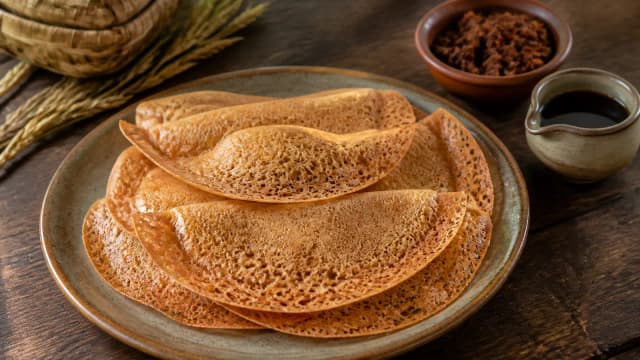
A Sri Lankan honey hopper, or pani appa in Sinhala, is a fermented rice and coconut hopper sweetened with jaggery and folded in half in the pan. Ignore the name: the 'honey' is pani, the sweetness of the kithul palm, either grated jaggery stirred through the batter or the dark syrup drizzled on afterwards, not bee honey. This is the jaggery-in-the-batter version, so every bite is sweet and faintly caramel, with a soft middle and thin, lacy edges. It's a much-loved breakfast and teatime sweet, and the batter is the same fermented rice and coconut one that makes a plain hopper.

Grated jaggery goes into the batter, so the hopper cooks sweet, brown and soft, then gets folded in the pan. Breakfast and teatime comfort.
- Total time
- 55 min
- 25 min prep · 30 min cook
- Serves
- 6 people
- Difficulty
- Beginner
- Spice level
- Mild
- Country help
- USA · UK · AU · CA substitutes included
CeylonCooking
ceyloncooking.com/recipes/honey-hopper
Sri Lankan Honey Hopper (Pani Appa)
Scan to open on your phone
Nutrition
Estimated values, per serving.
About This Dish
A hopper, appa in Sinhala and appam in Tamil, is a tiny daily miracle: a fermented rice and coconut batter swirled up the sides of a small round-bottomed pan until it cooks into a bowl with a thin, crisp, lacy rim and a soft, faintly sour centre. Most mornings that bowl gets filled with sambol. Sweeten the batter with jaggery instead, and the same hopper turns into pani appa, the honey hopper, a sweet that pulls breakfast towards dessert.
The name causes endless friendly confusion. In Sri Lanka, pani usually means treacle, not bee honey. A pani appa means a hopper sweetened with the kithul palm, whether that comes as hakuru, the grated jaggery that dissolves into the batter, or as the amber-to-mahogany syrup tapped from the kithul flower and boiled down. It's the same pani that pools over a wobbling watalappam or a plate of curd. So when someone hands you a honey hopper, they're almost never reaching for a jar of bee honey.
Honey hoppers sit on the gentler edges of the day. You'll see them at breakfast next to a savoury hopper or two, the sweet one saved for last, and again at teatime with a pot of strong milk tea, when you want something small and sweet but not a whole pudding. The contrast is the whole point: faint sourness from the fermented batter against the deep, almost burnt-sugar sweetness of the jaggery, thin crisp edges against a soft middle.
Ask around and you will get two answers about where the sweetness goes in. The one below, and the one most Sri Lankan cooks use for pani appa, is jaggery grated straight into the fermented batter, so the hopper cooks brown and sweet the whole way through and gets folded in half in the pan while it is still soft. The other is to cook the hoppers plain and spoon kithul treacle into the soft centre as each one comes out, which keeps the syrup raw and smoky and the rim crisp. Step 9 covers that version if you would rather have it that way.
A good honey hopper is all about restraint. Jaggery in the batter browns fast, so the flame stays moderate and the batter stays thin, and you resist the urge to leave a thick pool in the middle. Too much sweetness and too much heat and you get a heavy, sticky hopper with scorched edges. Get the balance right and you have one of the simplest, loveliest sweets on the Sri Lankan table: batter and palm sugar, nothing more.
Jaggery and Kithul Treacle (Hakuru and Pani)
Both come from the same place: the flower of the kithul palm, the fishtail palm, tapped for a cloudy sap called telijja. Boil that sap down and it becomes kithul pani, a thin, dark, pourable treacle with a body somewhere between maple syrup and molasses. Boil it further and it sets hard into kithul hakuru, the palm jaggery sold in blocks and cakes. The flavour of both is unmistakable: deep and caramel-like with a faint smokiness and a gentle, woody bitterness behind the sweetness, nothing like the floral lightness of bee honey.
For this recipe you want the jaggery, grated so it dissolves through the batter without lumps. Kithul hakuru is the prized one, though the darker coconut jaggery sold in most South Asian shops works well and is easier to find. Treacle is the other route: it goes in at the very end, raw and unheated, so its smoky character sits bright against the soft, faintly sour hopper. Cooked into the batter as jaggery, that same smokiness mellows into something rounder and more caramel-like.
What It Should Taste Like
Sweet the whole way through, brown and faintly caramel from the jaggery, with a soft, spongy middle and thin edges that crisp and catch at the rim. The fermented batter leaves a gentle sourness underneath, so it reads as a sweet treat rather than a pudding.
Ingredients
This recipe makes 6 servings. Change the number and every amount below updates with it. Substitutes for hard-to-find items are in the sidebar.
The US button converts grams, millilitres and centimetres to ounces, cups and inches. Spoon measures stay exactly as they are.
Open this in the recipe converter
Batter
- Wet-milled rice floursifted through the finest strainer you have. 2 tbsp of it goes into the starter paste in step 1320 g
- Waterplus a splash for the starter paste and for loosening1 cup
- Coconut milk1 cup
- Jaggeryabout 150 g. Kithul hakuru or coconut jaggery1 cup, grated
- Baking soda1/2 tsp
- Salt1 tsp
Method
Steps 1 to 4 build the batter over about seven hours, most of it hands-off, and steps 5 to 8 cook the hoppers. Step 9 is the other version, if you would rather cook them plain and drizzle treacle on at the table.
Ready to Start Cooking?
The screen shows one step at a time, with just the ingredients that step needs at your serving count, a timer you can tap, and your phone kept awake.
- 01
Cook a Little of the Flour into a Starter Paste
Take 2 tablespoons of the rice flour, mix it to a smooth paste with a little water, then cook it over a low flame, stirring without stopping, until it thickens. Take it off the heat, let it cool completely, then stir in a little more water to loosen it back into a liquid.
This cooked paste is what gets the ferment going, standing in for the coconut water or toddy an older kitchen would have used. Cooking the flour swells the starch and gives the wild yeasts in the air something easy to work on, so a batter with no yeast in it still comes alive overnight. Stir it constantly or it catches on the bottom of the pan, and let it cool right down before it goes anywhere near the rest of the flour, since heat kills off the very thing you are trying to start.
Tip: It thickens suddenly, in a few seconds, like a roux. Pull it off the flame as soon as it holds a trail behind the spoon.
- 02
Mix and Ferment the Batter
Stir the loosened starter into the rest of the rice flour, then add water a little at a time until you have a batter of medium consistency. Cover it and leave it to ferment for 6 hours.
Fermentation is what makes a hopper a hopper, sweet or savoury, so don't rush it. The starter works through the rice flour and leaves the batter loose, foamy and faintly sour, and that gentle tang is what pushes back against the jaggery later. It's ready when the surface is covered in small bubbles and it smells lightly sour, like a sourdough starter. Warmth is what it wants, so in a cold kitchen shut it in a cupboard or pantry, where the air is still and a few degrees warmer.

Tip: Medium consistency at this stage, not thin. The coconut milk goes in afterwards and loosens the batter again.
- 03
Add the Coconut Milk and Strain
Pour the coconut milk into the fermented batter and stir it through, then pass the whole lot through a fine strainer. If coarse flour stays behind in the mesh, grind it finer, stir it back in and strain again.
Straining is the step people skip and then wonder why the edges never go lacy. Any grit of unground rice sits in the batter and drags on the pan as you swirl, so the film up the sides tears instead of setting thin and even. Push the batter through with the back of a spoon and you will feel exactly how fine your flour was. Wet-milled rice flour usually goes through in one pass, while a dry shop-bought flour often needs the second.
Tip: The batter should now pour like single cream. If it drags on the spoon, loosen it with a splash of water before you go on.
- 04
Stir in the Jaggery, Soda and Salt, Then Rest
Add the grated jaggery, the baking soda and the salt to the strained batter and mix until the jaggery has dissolved. Taste it, then leave the batter to rest for one more hour.
The sweetening goes in now, after the ferment and not before it. A batter loaded with sugar from the start ferments sluggishly and comes out flat, whereas jaggery stirred into a batter that has already risen just dissolves and colours it the shade of milky tea. The soda gives it a last lift in the pan, the salt sharpens the sweetness, and the hour of rest lets everything settle and the jaggery finish dissolving. Taste at this point, because jaggery blocks vary in sweetness, and this is your only chance to adjust.
Tip: Grate the jaggery rather than chopping it. Lumps take an age to dissolve and one that survives into the pan will scorch.
- 05
Heat the Pan
Heat a non-stick hopper pan (appa kataya) or a small curved non-stick pan over medium heat, on a burner that spreads the flame evenly. If your pan is not non-stick, wipe it with the thinnest film of oil on kitchen paper.
A sweetened batter is sticky, so non-stick matters far more here than it does for a plain hopper. The sugar grips bare metal and tears the hopper when you try to lift it. An even flame matters just as much: a burner with a hot centre browns the middle of the hopper while the edges are still pale. Treat your very first hopper as a practice run while the pan finds its temperature, the way cooks everywhere quietly eat the first one themselves.

Tip: Medium heat from the first hopper to the last. A jaggery batter has nowhere to hide on a fierce flame.
- 06
Swirl the Hopper
Pour a ladle of batter into the hot pan and swirl it round two or three times so the batter coats the sides. Spread it out rather than letting a thick pool sit in the centre.
The rotation has to happen in one smooth, confident motion, before the batter slides back down. Two or three turns is enough. With a sweet batter you want it spread thinner than you would for a savoury hopper, because a deep pool in the middle stays wet long after the edges have coloured, and waiting for it to set is what burns the rim. Thin and even cooks through in the two minutes it gets.

Tip: Tilt and turn the pan in a continuous circle rather than sloshing it back and forth, which thins the rim unevenly.
- 07
Cover and Cook
Cover the pan and cook on medium heat for about 2 minutes, until the middle is set and no wet batter is left. Don't turn the flame up.
The lid traps the steam and cooks the soft middle from above, so it sets without ever being flipped. Keep the heat where it is. A higher flame blows big holes through a sweet batter and colours the edges long before the centre is done, and the jaggery catches quickly once the pan runs hot. Listen for the sizzle to settle down as the moisture cooks off. That's your cue it's nearly there.

Tip: Two minutes is the guide, not the rule. Go by the surface: matte and dry all over, with no shine left in the middle.
- 08
Fold It in the Pan and Serve
Slide a thin spatula under one side to lift the hopper free, fold it in half in the pan, and leave it another 30 seconds or so to set. Lift it out and cook the rest of the batter the same way.
The fold is what makes a pani appa look like a pani appa: a soft brown half-moon rather than an open bowl. Do it in the pan while the hopper is hot and pliable, because a minute on the plate and it stiffens and cracks along the crease. Those last 30 seconds press the two halves together and firm up the fold so it holds its shape. Ease the spatula all the way round the edge first, or the thin lacy rim tears as you lift.

Tip: Stack them as they come off the pan and cover them with a cloth. They stay soft, and honey hoppers are best eaten warm.
- 09
Or Make It the Drizzled Way
For the other version, leave the jaggery out of the batter and cook the hoppers plain, then spoon 1-2 teaspoons of kithul treacle into the soft centre of each one as it comes out of the pan. Don't fold these: the treacle needs the bowl shape to pool in.
This is the version you meet at hotel breakfast counters, and it tastes noticeably different. The treacle never sees the heat, so it stays raw and smoky, and you get all three things in one spoonful: crisp rim, soft centre, dark syrup sitting in the well. Timing is everything with it. Pour the treacle as the hopper reaches the table, not minutes ahead, or the middle goes soggy and the rim softens. Neither version is more correct than the other, and plenty of cooks sweeten the batter lightly and still pass the treacle jug round.

Tip: Pour the treacle in a slow spiral from the centre outwards, so it pools in the middle instead of running straight off the crisp rim.
Common Mistakes to Avoid
- Stirring the jaggery in before the batter ferments. The sugar slows everything down and you get a flat, dense hopper instead of a light one.
- Skipping the straining, so grit from the flour drags on the pan and the edges never go thin and lacy.
- Leaving a thick pool of batter in the centre, which stays wet long after the edges have coloured.
- Turning the flame up to speed things along. A jaggery batter blows big holes and scorches at the rim.
- Cooking a sweet batter in a pan that isn't non-stick, so the hopper sticks and tears as you lift it.
- Folding it once it has cooled, so it cracks along the crease instead of bending.
Serving Ideas
- For breakfast, have it alongside one or two savoury plain hoppers and save the sweet one for last.
- At teatime, with a pot of strong Sri Lankan milk tea.
- Serve scattered with fresh grated coconut for a little texture against the sweetness.
- Serve with a spoonful of thick coconut milk or curd on the side for a richer, dessert-like treat.
Building a whole plate around it? Start from our sri lankan breakfast menu, which sets out what to cook alongside it and in what order.
Storage and Make-Ahead
Eat honey hoppers warm, on the day you make them. They stiffen as they cool and they don't reheat well, though a covered stack stays soft for an hour or so. Cook the whole batch once the jaggery is in, since a sweetened batter thickens and dulls in the fridge. An unsweetened fermented batter keeps about 1 day in the fridge, so you can strain and sweeten it the next morning instead.
Two Ways to Cook It
Use sifted shop-bought rice flour and a small non-stick pan, and if the wild ferment worries you, stir 1/2 tsp of instant yeast into the batter in place of the cooked starter paste. Cook the hoppers a shade thinner than you think you should, and don't worry if the first two tear as you fold them.
Grind your own wet rice flour, get the ferment going with the cooked starter paste or a splash of toddy, and grate kithul hakuru into the batter rather than any other sugar. Cook them over a flame in an appa kataya, fold each one in the pan, and eat them warm with strong milk tea.
Lighter and Healthier Version
A honey hopper is already one of the lighter sweet treats you can make. No deep-frying, naturally gluten-free and dairy-free. It's built on fermented rice and coconut rather than wheat and butter, and the sweetness comes from a modest amount of palm sugar. A few small tweaks make it lighter still, or fit it to different diets.
Naturally Gluten-Free and Dairy-Free
Hoppers are made with rice flour and coconut milk, so they contain no wheat and no dairy. That means they suit gluten-free and lactose-free eaters as they are. Just check your rice flour is certified gluten-free if that matters to you.
Naturally Vegan with Jaggery or Treacle
Kithul jaggery and kithul treacle are both plant-based, so a pani appa is fully vegan as written. If you finish it with bee honey instead, it's no longer vegan, so stick with the palm sugars or another date or palm syrup.
Go Easy on the Jaggery
Cut the jaggery to two-thirds and the hopper is still clearly sweet, just gentler, and it browns less fiercely in the pan. Taste the batter before it rests and you can judge it for yourself.
Use Light Coconut Milk
Swap full-fat coconut milk for light, or thin it with water. That cuts the fat while keeping the airy texture. The fermentation, not the richness, is what makes a hopper special.
Go Easy on the Oil
A non-stick pan needs almost no oil at all, and a sweet batter releases better from non-stick than from an oiled bare pan anyway. That keeps each hopper light.
Frequently Asked Questions
A honey hopper, pani appa in Sinhala, is a Sri Lankan hopper made sweet: the same fermented rice and coconut batter, with grated jaggery stirred through it, cooked in a hopper pan and folded in half while it is still soft. It's eaten as a breakfast or teatime treat, the gentle sourness of the fermented batter playing against the deep, caramel sweetness of the palm sugar. Some cooks make it the other way, cooking the hoppers plain and drizzling kithul treacle into the centre. It's also called a treacle hopper or sweet hopper.
Cooked It? Tell Us How It Went
Your notes on this sri lankan honey hopper help the next person get it right: what you swapped, what you would do differently, where the recipe should have warned you. Tap a star if you are in a hurry, or write a few lines if you have a minute.
You Might Also Like


Sri Lankan Home Cooking Starter Pack
40 authentic Ceylon recipes made simple for foreign kitchens: spice guide, pantry checklist, substitute guide, 7-day meal plan and printable shopping lists.